
Bookkeeping vs Accounting: What You Actually Need at Each Stage
Request a Free Quote
Introduction
In my ten years of navigating the chaotic yet rewarding landscape of Pakistani business finance, I’ve seen a recurring pattern. A founder in Karachi launches a brilliant SaaS startup, or a freelancer in Islamabad starts billing $5,000 a month. For the first year, everything is “managed” on a messy Excel sheet or a physical diary. Then, the first FBR notice arrives, or a potential investor asks for a verified P&L statement, and suddenly, the “record-keeping” falls apart. This is where the confusion between bookkeeping and accounting transitions from a semantic debate to a financial crisis.
Choosing the wrong professional at the wrong time costs Pakistani businesses millions in avoidable taxes, penalties, and lost opportunities. If you hire a high-level accountant to do data entry, you are burning cash. If you expect a bookkeeper to handle complex tax compliance for small businesses in Pakistan, you are inviting a legal nightmare.
This guide is designed for:
- Startups are trying to stay lean while preparing for seed rounds.
- Small and Medium-Sized Enterprises (SMEs) are struggling with accounting regulations in 2026.
- Freelancers are wondering if they need a professional or just a software subscription.
By the end of this article, you will have total clarity on whether you need bookkeeping or accounting, a realistic view of cost, and a roadmap for scaling your financial department as your revenue grows.
Bookkeeping vs Accounting: The Core Difference
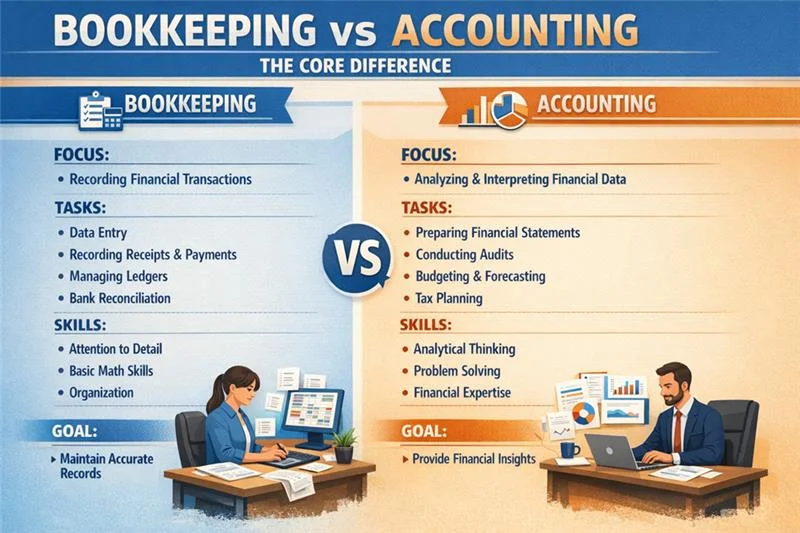
Accounting and bookkeeping in Pakistan can be easily understood by thinking about building a house.
Think of bookkeeping like the person laying the bricks for your business. A good mason makes sure every single brick is level, correctly placed, and accounted for.
In the same way, bookkeeping is just that daily, careful work of logging every transaction. It’s about making sure nothing gets missed and no detail is forgotten so that, at the end of the day, you have a solid wall to stand on.
Accounting is more like the architect. They take those records and analyse them to see the bigger picture. While bookkeeping handles the administrative “paperwork,” accounting turns those numbers into a story about how healthy your business is, and how many more floors your foundation can support.
What Does a Bookkeeper Do vs. an Accountant?
When business owners ask, “What does a bookkeeper do vs. an accountant?”, they are often looking for a task list. In Pakistan, roles overlap more than in the West because of the complex nature of withholding taxes and manual documentation.
A Bookkeeper focuses on:
- Daily Transaction Recording: Entering every sale and purchase into the system.
- Invoicing & Expenses: Sending out invoices to clients and tracking utility bills or office rent.
- Bank Reconciliation: Ensuring your Bank Alfalah or HBL statement matches your ledger.
- Data Accuracy: Ensuring no expenses are missed so your “Khata” remains clean.
An Accountant focuses on:
- Financial Statements: Preparing the Balance Sheet, Profit & Loss, and Cash Flow statements.
- Tax Strategy: Not just filing, but planning how to minimise liability legally under the Income Tax Ordinance.
- Strategic Reporting: Telling you which product line is bleeding money.
- Audit Readiness: Ensuring the books stand up to scrutiny from the SECP or FBR.
Comparison at a Glance
| Feature | Bookkeeper | Accountant |
|---|---|---|
| Primary Goal | Record accuracy | Financial insight & compliance |
| Focus | Past/Present (Daily) | Past/Future (Strategic) |
| Outputs | General Ledger, Reconciliations | Financial Statements, Tax Returns |
| Typical Tool | Excel, QuickBooks, Zoho | ERPs, Tax Portals (IRIS), Advanced Analysis |
| FBR Interaction | Minimal (Basic documentation) | High (Handling notices/audits) |
Bookkeeping vs Accounting Process in Pakistan
Our local tax regime heavily influences the distinction between accounting and bookkeeping in Pakistan. Unlike jurisdictions with simplified “flat taxes,” Pakistan’s system is riddled with withholding agents, provincial sales taxes (SRB, PRA), and federal requirements.
Bookkeeping Process for Small Businesses in Pakistan
The bookkeeping process for a small business in Pakistan must be disciplined. I always tell clients: “Bad data in, bad data out.”
- Daily Recording: Every petty cash expense (e.g., office tea, generator fuel) must be logged.
- Weekly Reconciliation: Check your digital bank transactions against your records.
- Monthly Closing: Ensure all salary payments and vendor payments are accounted for.
- Record Retention: Under the latest accounting regulations in Pakistan, you must retain physical/digital records for at least 6 years. This includes sales tax invoices and withholding evidence.
Accounting Process in Pakistan
Once the bookkeeping is done, the accountant for the business steps in to perform:
- Adjustment Entries: Calculating depreciation on your office equipment or accruals for unpaid bills.
- Compliance Review: Checking if withholding tax was deducted on payments to vendors.
- Reporting: Presenting a report that shows your “Burn Rate”.
Bookkeeper vs Accountant Salary & Cost Comparison (Pakistan)
Budgeting is where most owners get stuck. The bookkeeper vs accountant salary gap in Pakistan is wide because of the qualification levels (B.Com/MBA vs. ACCA/CA/CPA).
Bookkeeping Services Cost in Pakistan
The cost of bookkeeping services varies based on transaction volume.
- Freelance Bookkeeper: PKR 15,000 – 30,000 per month (part-time).
- Full-time Junior Bookkeeper: PKR 40,000 – 60,000 per month.
- Outsourced Bookkeeping Firm: PKR 20,000 – 50,000 per month (often more reliable than a single freelancer).
Accounting Services Cost in Pakistan
The accounting services cost in Pakistanis higher because you are paying for liability and expertise.
- Tax Consultant (SME level): PKR 50,000 – 150,000 per year for annual filings.
- Retainer-based Accountant: PKR 40,000 – 100,000 per month for monthly compliance and reporting.
- Audit Services: For Private Limited companies, statutory audits can start from PKR 75,000 and go up significantly based on turnover.
When you’re looking at the cost of an accountant versus a bookkeeper in Pakistan, it helps to see them differently. A bookkeeper is a daily operational cost to keep things organised, while an accountant is more of a protective investment. Having a professional looking over your shoulder can save you from FBR penalties that often run into hundreds of thousands of rupees.
Small Business Bookkeeping Requirements in Pakistan
If you are a business owner, you cannot ignore the requirements for small business bookkeeping. The FBR is becoming increasingly digital. By 2026, the integration of POS systems and the “Tajir Dost” schemes means that manual, hidden books are a massive risk.
Basic Bookkeeping Checklist (Pakistan)
I recommend that every client maintain this basic bookkeeping checklist in Pakistan:
- Sales Ledger: Date, Customer Name, NTN (if applicable), Amount, Sales Tax.
- Purchase Ledger: All supplier invoices.
- Bank Statements: Monthly PDF/Physical copies from all business accounts.
- Payroll Register: Showing gross salary, tax withheld, and net paid.
- Withholding Tax Certificates: Evidence of tax deducted on your behalf (Challans).
- Asset Register: A list of all furniture, laptops, and vehicles owned by the business.
Tax Compliance & Accounting Regulations in Pakistan (2026)
The landscape for local tax compliance for small businesses is shifting. With the accounting regulations updates in 2026, there is a push for “Real-time reporting.”
What the FBR Expects from Small Businesses
The FBR doesn’t care if you call your staff a bookkeeper or an accountant. They care about:
- Income Tax Filings: Annual returns based on accurate financial statements.
- Sales Tax (STRN): Monthly filings if you cross the threshold (currently generally PKR 5M for retailers, but check specific provincial rules).
- Withholding Obligations: If you are a “Prescribed Person,” you must deduct tax from your landlord, employees, and suppliers and deposit it via CPR.
Failure to do this leads to “Best Judgment Assessments,” where the FBR decides how much tax you owe, and they never guess in your favor.
Case Study: From Chaos to Compliance
Client: A Lahore-based E-commerce Startup.
The Situation: In 2024, they were generating monthly sales of PKR 5 million. They used a part-time “entry guy” for bookkeeping. When they tried to raise a Bridge round, the VC’s due diligence team found that they hadn’t withheld tax on their warehouse rent for 2 years.
The Fix: We transitioned them from simple bookkeeping to a structured accounting services model. We cleaned 24 months of data, reconciled their bank accounts, and filed backdated returns.
Outcome: They cleared the audit and avoided potential penalties of PKR 1.2 million.
Testimonial:
“I thought I was saving money by not hiring an accountant. I was building a debt bomb. PFOC helped us defuse it before the investors walked away.” — Faraz S., CEO.
Bookkeeping vs Accounting for Startups in Pakistan
Early-Stage Startups (Pre-Revenue)
At this stage, bookkeeping is usually a DIY job. You have a few transactions. I suggest using a simple tool like Wave or a well-structured Excel sheet. Focus on tracking your “Founder’s Contribution” so you can withdraw it tax-free later.
Funded / Growing Startups
Once you raise seed funding, accounting services become mandatory. Investors want to see GAAP- or IFRS-compliant financial statements. You need an accountant to manage the “Cap Table” and ensure that your burn rate is accurately reported.
Bookkeeping vs Accounting for Freelancers in Pakistan
The most common question I get is: Do freelancers need an accountant in Pakistan?
If you are a solo freelancer earning under PKR 1 million a month, a bookkeeper is overkill. You need a solid system to track your foreign remittances (to claim the 0.25% or 1% reduced tax rate). However, once you start hiring a team or renting an office, you move into the territory of both bookkeeping and accounting. You now have payroll and rent withholding to manage.
When to hire an accountant in Pakistan as a freelancer?
- When you receive an FBR notice.
- When you want to register a PVT Ltd company with the SECP.
- When your annual income exceeds PKR 5 million, you need to optimise your tax bracket.
When to Hire an Accountant in Pakistan (Stage-Based Guide)
Knowing when to switch from bookkeeping to accounting is about revenue and complexity.
- The Survival Stage (0 – 10M PKR Turnover): Stick to bookkeeping. Focus on tracking cash.
- The Growth Stage (10M – 50M PKR Turnover): This is when you need to hire an accountant on a part-time or consultancy basis. You need someone to review your books quarterly.
- The Professional Stage (50M+ PKR Turnover): You need full-scale accounting and tax services. The risks of an audit are too high to DIY.
Do I Need Bookkeeping or Accounting?
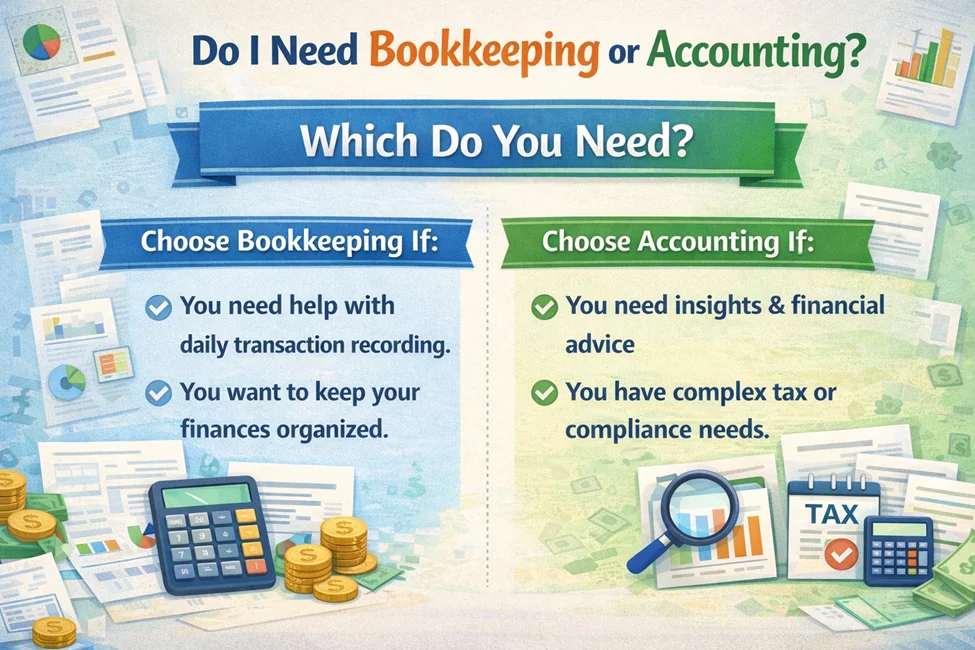
To help you decide how to choose between an accountant and bookkeeper, ask yourself these four questions:
- Is my data organized? If you have piles of unrecorded receipts, you need a bookkeeper.
- Am I tax compliant? If you don’t know your withholding status, you need an accountant.
- Is my business growing? If you are scaling, you need the strategic insight of an accountant.
- What is my budget? If you can only afford PKR 20k/month, start with a bookkeeper or software.
Tools & Software for Bookkeeping in Pakistan
In 2026, manual registers will be obsolete. To lower your bookkeeping services cost in Pakistan, I recommend:
- QuickBooks Online: The gold standard, though getting expensive.
- Zoho Books: Excellent for VAT/Sales tax tracking.
- io: A great free/low-cost desktop alternative for small SMEs.
- Local Solutions: Some Pakistani startups are building FBR-integrated software; keep an eye on these for automated tax filing.
How PFOC Can Help?
At PFOC, we bridge the gap between simple record-keeping and high-level financial strategy. We understand that a startup in its first year doesn’t need a full-time CFO, but it still needs to be compliant.
We provide tailored accounting and tax services in Pakistan that grow with you. Whether you need bookkeeping for a small business or complex accounting services for a startup, our team ensures your books are audit-ready and your tax liability is minimised. We take the “math stress” off your plate so you can focus on building your business.
Conclusion
The debate between bookkeeping and accounting isn’t about which is “better”; it’s about which is right for your current stage. If you are just starting, focus on then bookkeeping process to ensure your data is clean. As you scale, invest in an accountant for your business to navigate the treacherous waters of tax compliance.
Ignoring your books is the fastest way to kill a profitable business. Be proactive, choose the right partner, and ensure your financial foundation is as solid as your business vision.
FAQS:
Bookkeeping means the administrative task of recording daily transactions, such as sales, rent, and fuel expenses. Higher-level than bookkeepers, the accountants at these firms are tasked with analysing these records to prepare financial statements, perform tax planning, and ensure that businesses remain in compliance with government regulations.
You must employ an accountant after you begin generating stable revenue, hire staff, or become a Private Limited company. You can do your own books early on, and later an accountant is required as soon as you must deal with withholding taxes (WHT) or want professionally audited reports for investors.
Part-time bookkeeping rates range from $15 to $30 per hour. For a small business, you can usually expect to pay somewhere between a full-time professional and a freelance professional. If you outsource to a company, its charges may range from 25k to 50k per month, depending on the volume of transactions they need to record and the number of bank accounts you have.
You must keep records of all your sales and purchases (as well as related expenses) for at least 6 years. That includes retaining invoices, utility bills, salary sheets, and your monthly bank statements, whether physical or digital, as evidence to defend your tax filings before the FBR.
Yes. A bookkeeper keeps your books organised, but they generally do not have expertise in tax law, FBR audits, and/or financial planning. You will also need an accountant to file the data your bookkeeper compiled and ensure it is correctly entered on the books, so you do not pay more tax than necessary.
Bookkeeping meets your legal duty to document expenses, and accounting meets your obligation to file accurately. Without bookkeeping, you don’t have the records to prove your tax write-offs, and without accounting, you may miss income tax or sales tax deadlines.
You only need rudimentary daily bookkeeping to monitor your income, but you need an accountant for your annual tax return. They also ensure you qualify for the attractive reduced tax rates for IT exports (0.25% to 1%) and assist with the collection of the relevant bank certificates confirming that your income originated abroad.
If your personal battle is with incomplete records, lost receipts, and not understanding your daily cash position, then hire a bookkeeper. So, whether your challenge is processing FBR notices, submitting your annual tax return, or simply finding out whether you are even making any profit in business, you need an accountant.
Solid record keeping leaves a ”paper trail.” When you file your taxes, your accountant takes these records to deduct expenses. If the FBR audits you, well-kept books mean they cannot disallow your expenses or impose heavy penalties.
Switch when your business outgrows simple cash transactions. As soon as you begin dealing with Sales Tax (STRN), have more than 5-10 full-time equivalent staff, or turn over more than PKR 10 million p/a, it becomes too risky in terms of legal exposure for a bookkeeper to handle alone.
Bookkeeping is an exercise of ”accuracy”, so that every rupee can be accounted for. That’s where “accounting,” or “legality”, comes in, ensuring the FBR remains well-fed about those rupees on your tax returns as per current taxation rules, so you don’t get penalised.
No. Bookkeeping itemises every transaction, but proper financial reporting (e.g., a Balance Sheet or Cash Flow Statement) requires professional adjustments, such as depreciation of assets, recognition of unpaid liabilities, etc. Banks and investors generally only want to see reports signed off by an accountant.
There is nothing that obliges you to hire an accountant. Still, the FBR’s filing portal (IRIS) is not newbie-friendly.” A bean counter is suitable for personal tracking. Still, you also ABSOLUTELY need an accountant to ensure that you are filed as an “active taxpayer” and using the correct tax codes.
It’s the law: You need to keep a “true and fair” account of how you earn your living. That implies that for every entry in your books, you should have a voucher to back it up (such as a receipt). The FBR taxes you on an “estimated” income if you do not present them with these during a tax check, invariably resulting in an inflated bill.