
 Business Development Services
 Tax planning Services
 Accounting Services Pakistan
 Financial Consultancy Services
 Statutory Compliance Services
 Investment Consulting Services
 FBR POS Integration & Invoicing
 Call Centre Compliance Services
 Compliance for Software Houses
 Legal Consultancy Services
 Managed IT Support Services
 Performance Marketing Services
 Digital Marketing Services
Business Budget Planning in Pakistan: A Monthly System That Actually Gets Used
Request a Free Quote
Introduction
Most people get this wrong in the same way. They hear “risk” in a financial report and think it means one thing. It doesn’t.
Here’s the mix-up. Business risk is about your company’s survival and growth. Audit risk is about whether the auditor’s opinion is correct. These are two different questions. They come from two different people, for two different reasons. Mixing them up isn’t just a small slip. It makes owners misread audit reports.
This guide clears up the mix-up for good. We’ll cover what each term means. We’ll show how they connect. We’ll walk through the formula auditors use. We’ll look at how this plays out in Pakistan under SECP rules. And we’ll point out where people trip up the most.
What Is Business Risk?
Business risk is anything that could stop your company from hitting its goals. That’s the whole idea. No financial statements are needed.
It covers a wide range of threats. A rival cuts their prices. A key supplier shuts down. The rupee drops and your import costs jump. A new rule forces you to change how you work. Your biggest client walks away. All of that counts as business risk.
Auditing rules define it in a similar way. Business risk comes from events or actions that hurt a company’s shot at reaching its goals. Notice what’s missing here. No mention of financial statements. No mention of auditors. Business risk exists whether anyone ever audits your company.
Common types of business risk include:
- Financial risk. Cash flow trouble, too much debt, bad credit calls, or swings in the rupee.
- Operational risk. Supply breaks, broken machines, or losing key staff.
- Strategic risk. Picking the wrong market, missing a shift in demand, or a failed launch. A lot of this risk gets decided long before year-end, in how a company plans its business development strategy and chooses which markets to chase.
- Compliance risk. Falling behind SECP filings or FBR tax rules.
- Reputational risk. A scandal or bad press that scares customers or investors.
The worst version of business risk is simple. Your company stops being a going concern. It fails.
What Is Audit Risk?
Audit risk is narrower. It’s the risk that an auditor gives the wrong opinion on your financial statements.
That’s the formal idea, too. Audit risk is the chance that an auditor says your numbers are fine when a real error sits inside them. Or, less often, the auditor raises a flag on numbers that are actually fine.
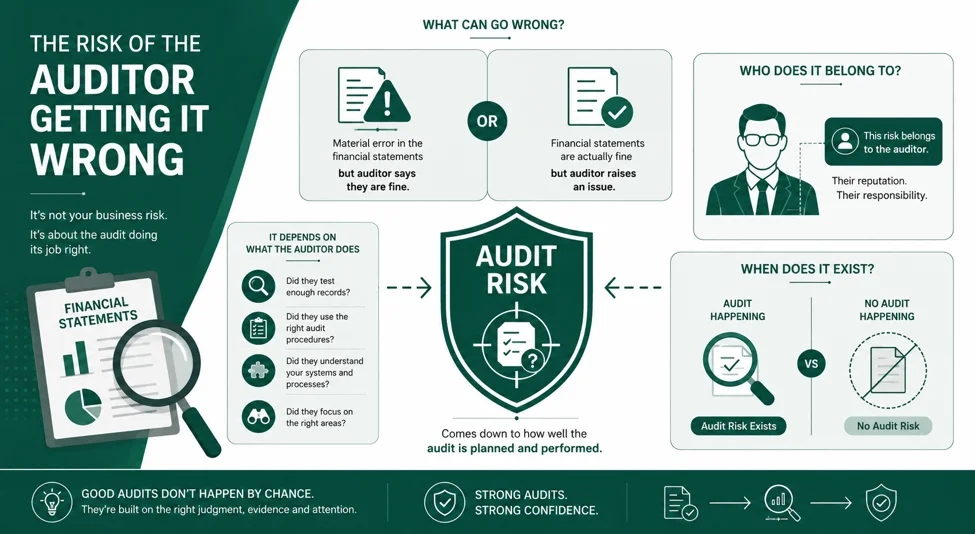
This risk belongs to the auditor. Not to your business. It’s about whether the audit itself does its job. Did the auditor catch the errors that matter? Did they test enough records? Did they understand your systems well enough to know where to look?
Audit risk only shows up once an audit is happening. No audit, no audit risk. But your business risk never goes away, audit or not.
Business Risk vs Audit Risk: The Core Difference
Here’s the simplest way to remember it.
Business risk asks: will this company survive and hit its goals?
Audit risk asks: will the auditor’s opinion on this company’s numbers be right?
| Factor | Business Risk | Audit Risk |
|---|---|---|
| Who owns it | The business and its managers | The auditor |
| What it threatens | Survival, profit, reputation | The accuracy of the audit opinion |
| When it exists | All the time, audit or not | Only during an audit |
| Scope | Wide. Covers the whole business | Narrow. Covers the financial statements |
| Example | Losing a major client | Auditor misses fraud in the sales numbers |
They’re linked, but they’re not the same thing. A company can face big business risks, like a shrinking market or rising costs, and still get a clean audit opinion. Why? The numbers happen to be accurate, even if the business is struggling. On the flip side, a stable, low-risk business can still end up with high audit risk. Maybe the audit team is new. Maybe they rushed to work.
The link runs more in one direction. High business risk often leads to higher audit risk. Why? Struggling firms face more pressure to bend the numbers. But audit risks don’t create business risks. A bad audit opinion can hurt your reputation, sure. But the real business problems were already there before the audit started.
How Business Risk and Audit Risk Actually Connect
Auditors don’t ignore business risks. There’s a global rule for this called ISA 315. It says auditors must learn about your business before they test a single number.
Why does this matter? Business risks tend to show up in financial statements eventually. Say your company is losing cash after a failed expansion. That shows up as low cash, rising debt, or pressure from management to make things look better than they are. A sharp auditor who understands your business risk knows where to dig.
This is why a good auditor asks about your industry, your rivals, your biggest customers, your loans, and your growth plans. They’re not being noisy. They’re mapping your business risk, so they know where audit risk is most likely to hide.
Audit Risk Components, Explained Simply
Audit risk isn’t one single thing. It breaks down into three parts. Auditors plan their whole approach around these three.
Inherent risk
This is the natural risk that a mistake or fraud sits in your books, before anyone checks anything. Tricky deals push this risk up. So does heavy guesswork or a messy industry. A builder with long-term jobs has a higher inherent risk than a small shop that sells for cash.
Control risk
This is the risk that your internal checks fail to catch a mistake. Strong checks, like needing two signatures for big payments, push this risk down. One person controlling everything with no one watching pushes it away.
Detection risk
This is the risk that the auditor’s own tests fail to catch a mistake that’s there. It depends on how much testing they do, how skilled the team is, and how good their sampling is.
Audit Risk Formula Explained
Auditors use a simple formula to tie these three pieces together:
Audit Risk = Inherent Risk × Control Risk × Detection Risk
Here’s what it means in real life. If inherent risk and control risk are both high, the auditor has to push detection risk way down. That keeps overall audit risk at an okay level. In practice, that means more testing. Bigger samples. More hours spent digging.
Say an auditor rates inherent risk at 70%. Control risk comes in at 60%. They want overall audit risk under 10%. Using the formula, detection risk needs to land around 24%. That number tells the team how deep their testing needs to go.
This isn’t exactly about math like a calculator. It’s a planning tool. High risk in the first two spots means more hours and tighter checks. Low risk there means the team can move faster without skipping steps.
Audit Risk vs Inherent Risk: Don’t Mix These Up Either
This is a second mix-up that trips people up almost as much as business risk vs audit risk.
Inherent risk is just one piece inside audit risk. It’s the risk baked into your business and industry, before any checks or audit work happens. A bank doing complex trades has high inherent risk just by nature. A small bakery selling bread for cash has low inherent risk.
Audit risk is the result. You get it by mixing inherent risk, control risk, and detection risk together. Inherent risk feeds into audit risk. It’s not the same thing.
Quick way to remember it. Inherent risk is about the business and its deals. Audit risk is about whether the auditor’s final call is correct.
Business Risk Assessment Process
For business risk, the steps usually look like this:
- Spot the risks. List what could go wrong in operations, money, market position, and rules.
- Rank likelihood and impact. Score each risk by how likely it is and how much damage it would cause.
- Set priorities. Put your time and money toward the risks that are both likely and severe.
- Plan a response. Decide whether to avoid, cut, shift (through insurance, say), or accept each risk.
- Watch and review. Risks shift as markets and rules change. This isn’t a one-time job.
For audit risk, the steps are more set, and tied to formal rules:
- The auditor learns about your business, your industry, and your internal checks. This is the ISA 315 step.
- They rate inherent risk and control risk, both overall and account by account.
- They pick up an acceptable audit risk level and work out the detection risk needed to stay under it.
- They build their test plan, sample size, depth of testing, and focus areas, based on that math.
- They adjust along the way if new facts change the risk of picture mid-audit.
Business Risk and Audit Risk in Pakistan: What’s Different
A lot of the mix-up in Pakistan comes from how SECP and the Companies Act, 2017, set up audit rules. That’s separate from how ICAP-trained auditors talk about audit risk in technical terms.
Under the Companies Act, 2017, most private limited firms need a yearly audit by law. This kicks in once you pass a set of paid-up capital levels. A chartered accountant must do the work. They need to be registered with the Institute of Chartered Accountants of Pakistan, or ICAP. Smaller firms under certain limits may not need a full audit. Check your own firm’s exact status rather than guessing.
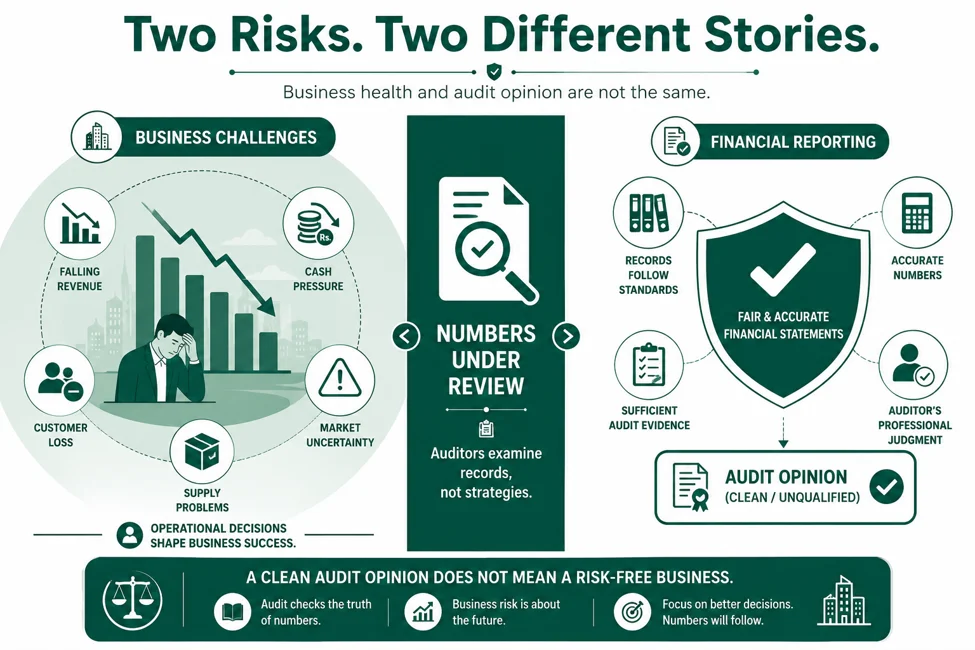
Here’s where local business owners trip up most. They treat the audit report as a grade on their business health. But really, it’s a check on whether the numbers in the books are fair. A business can carry real business risk, falling sales, tight cash, a shaky market, and still walk away with a clean audit opinion.
Why? Because the numbers in the books are accurate, even if the business itself is in trouble. The audit doesn’t grade your business choices. It checks your numbers.
Audit Timeline in Pakistan
A statutory audit needs to wrap up before the Annual General Meeting, since the audited accounts get shown there. Under the Companies Act, the AGM itself must happen within four months of the year-end. After the AGM, the annual accounts go to SECP within 30 days. Miss these dates and you face penalties. So, it pays to start the audit early in that window.
Audit Risk Compliance in Pakistan
Following the rules here means more than just hiring an auditor. It means your auditor is properly registered with ICAP. It means the first auditor gets named by the board within 90 days of company’s setup.
Later, auditors are named by shareholders at the AGM. Bigger private companies and public interest firms face extra checks under SECP rules too. This is the same registration window that newly formed companies need to track alongside their broader SECP, FBR, and NTN registration steps when they’re first setting up.
Audit Risk Checklist for Pakistani Businesses
Before your audit starts, it helps to have these ready:
- Updated books checked every month, not just at year-end.
- Bank records matched against your ledger.
- Paper trails for big deals, contracts, and loans.
- A clear record of any deals with related parties, since these draw extra attention.
- Last year’s audit report and management letter, if you’ve been audited before.
- Some record of your internal checks, even informal, showing who signs off on what.
Payroll is one of the easiest places for this paper trail to fall apart, since it touches salary tax, EOBI, and social security all at once, which is worth running through a proper payroll compliance checklist well before audit season rather than during it.
A company that walks into an audit with messy, last-minute books almost always faces higher audit risk. The auditor has less work to do. They have to dig harder.
External Audit Risk vs Internal Audit Risk in Pakistan
People often blend these two together, but they serve different jobs.
External audit risk relates to the independent yearly audit needed for SECP filing and the AGM. An outside firm, registered with ICAP, does this work. They have no day-to-day role in your business.
Internal audit risk relates to your own internal audit team if you have one. They check your work and your systems all year round, not just once. Not every company needs an internal audit team.
But larger firms and public interest companies often run one. They run it alongside the outside audit. A strong internal team can actually help the outside auditor too. It lowers control risk in their eyes.
What Is Business Risk in Auditing, Specifically
When auditors talk about “business risk” in their own work, they mean a narrower idea. They mean this. Which of your business risks could cause a real error in the financial statements?
Not every business risk matters to an auditor. Losing a small supplier might be a real business risk. But if it barely touches your numbers, the auditor won’t spend much time there. A risk that threatens whether your company can keep running is different. That gets real attention. Why? It changes how the statements should be written and shown.
So when you see “business risk” in an audit plan or report, it almost always means one thing. Does this risk matter to the financial statements, yes or no.
Who Gets Left Out or Struggles With the Standard Approach
The textbook version of all this assumes a mid-sized company. It has a finance team, decent books, and room in the budget for a full audit. Plenty of businesses in Pakistan don’t look like that.
Very small businesses and sole owners.
If you’re not set up as a company under the Companies Act, the statutory audit rules mostly don’t apply to you in the same way. But that doesn’t mean business risk goes away. You still face the same threats: cash flow, rivals, rules. You just don’t have an audit forcing you to write it all down.
Startups with no audit history.
A first-time audit is harder. There’s no prior file to check against. No track record of deals. Often weak or informal checks. This pushes inherent risk and control risk up in year one. That means more time and cost than most expect going in.
This is also the stage where founders are usually still working through early-stage startup consulting and haven’t yet formalized the systems an auditor would want to see.
Family-run firms with informal records.
Lots of small and medium firms in Pakistan run on a mix of formal books and informal habits: cash deals, verbal deals with relatives, assets held by a person instead of the company. None of these are unusual. But it raises audit risk a lot, since there’s less paper trail to check.
Overseas Pakistanis running a company from afar.
Sometimes the owner isn’t around to sign off in real time. Sometimes they can’t review papers in person. This creates gaps with the auditor and the local team. That slows things down. It also raises the odds of something getting missed.
Firms that treat the audit as a once-a-year box to tick.
If books only get done right before audit season, instead of monthly all year, audit risk climbs across the board. The audit itself usually takes longer and costs more too.
What Can Actually Go Wrong
Here’s where things tend to break down, based on real, repeat issues seen in audits and in exam guidance.
Mixing up risk to the business with risk to the audit opinion.
This is the mistake exam markers flag repeatedly. It happens in real boardrooms, too. A risk to your survival isn’t the same as a risk to the accuracy of your financial statements. It can work the other way, too.
Treating a clean audit opinion as proof the business is healthy.
A clean opinion means the financial statements are fair. It says nothing about whether your strategy is sound or whether you’ll still be open in two years.
Underrating control risk because “we trust our team.”
Trust isn’t a control. Auditors look for written steps, split duties, and sign-off trails. Not a good will.
Missing AGM and SECP filing dates because the audit ran late.
This happens often when books are a mess going into audit season. It leads to fines that have nothing to do with whether your numbers were even right.
Assuming small company status without checking current limits.
Capital limits change over time. So do exemption rules. If you assume you’re exempt without checking the current SECP rules, your firm could end up out of line. No one may notice until it’s too late.
Auditors and owners talking past each other.
Auditors ask about business risk to find audit risk. Owners sometimes hear those questions as a dig at their choices, not as fact-finding. Both sides do better when it’s clear which kind of risk is on the table.
A Final Note Before You Go
Business risk and audit risk aren’t rivals. They’re two lenses looking at related problems. One looks at your company’s survival and growth. The other looks at whether your financial statements tell the truth. Once you split the two apart, audit talks get a lot less confusing. You stop reading more, or less, into an audit report than it’s actually saying.
Maybe your books are a mess going into audit season. Maybe you’re not sure if your business risk is creating gaps. Those gaps could show up in your financial statements later. Either way, a financial check before the audit starts usually saves time and money.
PFOC’s financial consultancy services work with firms across Pakistan on exactly this. The team checks records. They flag gaps early. They get firms ready for audit before SECP deadlines or AGM dates turn into a scramble. A short chat upfront costs far less than fixing problems an auditor finds later.
Rules around audit limits and SECP deadlines change from time to time. So do ICAP rules. Always check the latest details with SECP or a qualified consultant before you act on anything in this guide.
FAQs
What is the main difference between business risk and audit risk?
Business risk is the chance your company fails to hit its goals or survive. Audit risk is the chance an auditor gives the wrong opinion on your financial statements. One is about the business. The other is about the audit.
Does high business risk always mean high audit risk?
Not always, but it often pushes audit risk up. A struggling company faces more pressure to bend the numbers. So, auditors usually test more carefully when business risk looks high.
What are the three parts of audit risk?
Inherent risk, control risk, and detection risk. Multiply them together and you get overall audit risk.
What's the audit risk formula?
Audit Risk = Inherent Risk × Control Risk × Detection Risk. Auditors use it to work out how much testing they need to keep overall risk at an okay level.
Is audit risk the same as inherent risk?
No. Inherent risk is one piece of audit risk. It’s the natural risk in your business before any checks or audit work happen. Audit risk is the final mix of inherent risk, control risk, and detection risk.
Do all companies in Pakistan need a yearly audit?
Most private, limited firms need one. This kicks in once they pass a set paid-up capital level, under the Companies Act, 2017. An ICAP-registered chartered accountant must do the work. Smaller firms may be exempt. Check your exact status with SECP or a qualified consultant, rather than guessing.
Can a business have a clean audit and still be in financial trouble?
Yes. A clean audit opinion only says the financial statements are fair. It doesn’t judge whether your business plan, market spot, or strategy makes sense.
How long does a statutory audit take in Pakistan before the AGM?
Time varies by company size and how tidy the books are going in. But the audit must wrap up before the AGM, which itself must happen within four months of the year-end. Accounts then go to SECP within 30 days of the AGM.
What raises audit risk the most for small and family-run businesses?
Loose record-keeping, cash deals with no paper trail, mixing personal and business assets, and weak splits of duties. These are the biggest drivers.