Is your company already registered with SECP? Then you can legally change its name, in much the same way you would have first worked through the SECP registration process for a private limited company. But the process has a few stages. It’s easy to get stuck halfway if you don’t know them.
First, you reserve the new name. Next, your company approves the change internally. Then you file the paperwork with SECP. Reserving a name isn’t the same as completing the change. Many business owners assume it is. That mix-up causes real delays.
Only one thing legally completes a company name change: SECP’s altered certificate of incorporation. Until SECP issues that certificate, your legal name hasn’t changed yet.
This guide walks through the full process for 2026. You’ll find the forms you need, the fees involved, and the steps to take once SECP approves your new name.
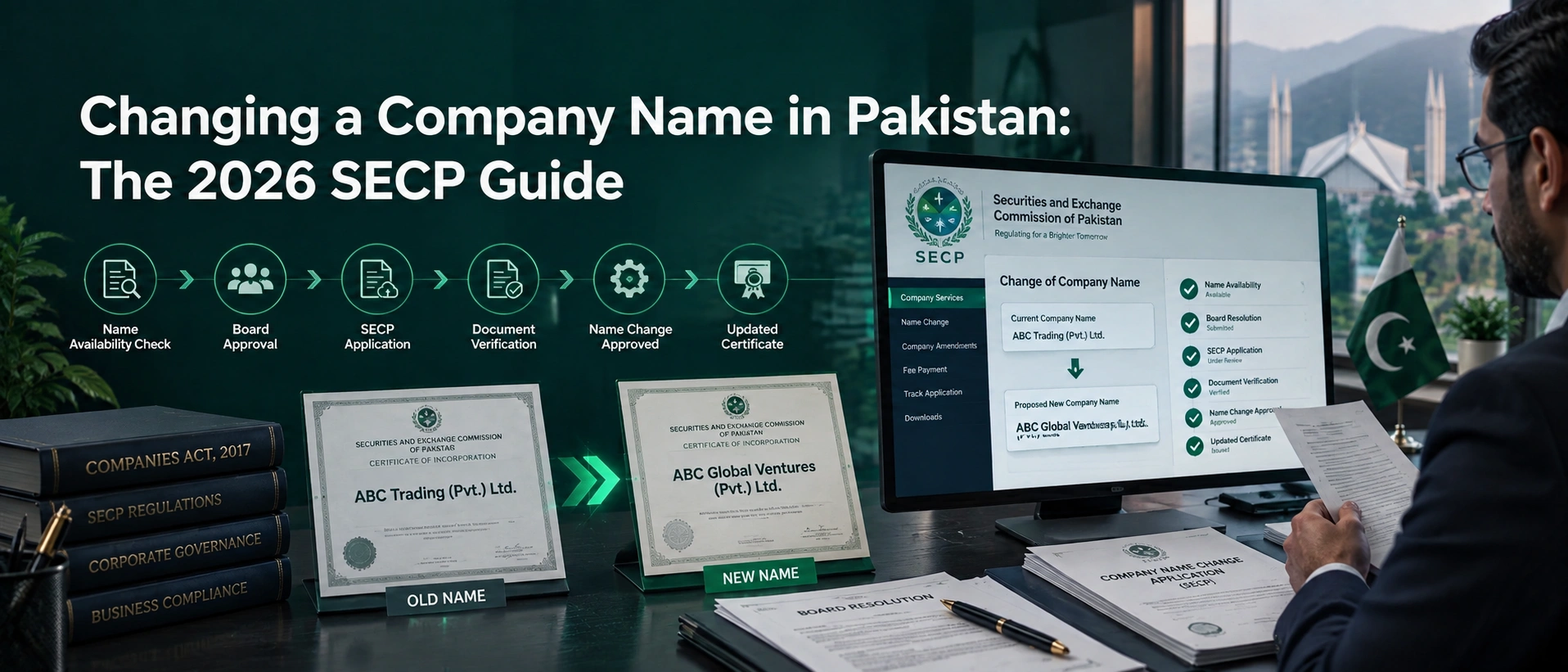
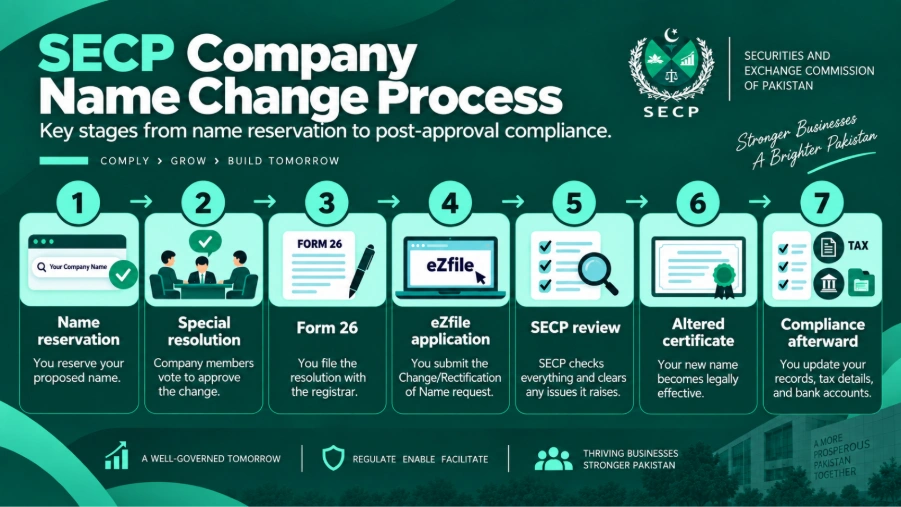
Here’s the short version. You reserve your proposed name. Then you pass a special resolution. Next, you file Form 26 within the deadline. Finally, you submit your name change request through SECP’s eZfile (LEAP) portal.
Once SECP approves your application, it issues an altered certificate of incorporation. That certificate makes the change official. Your earlier name reservation does not.
Yes. Section 12 of the Companies Act, 2017 allows this. Your members must first pass a special resolution. Then the SECP must give written approval.
Is your company regulated? For example, by the State Bank or PTA? If so, you must meet a few extra conditions first.
No. This is worth knowing upfront. Your company keeps the same incorporation date. It keeps the same CUIN. It keeps the same history too.
Every asset, liability, and duty carries over under the new name.
A name reservation only holds your chosen name. It holds it for a limited window. It doesn’t make the name official yet.
Your new name becomes legal only after SECP reviews your resolution and application. Then SECP issues the altered certificate. That’s the moment it counts.
Many companies treat the reservation step as the finish line. It isn’t. The certificate is the real finish line, not the reservation.
You’ll need a few things to change your company’s name. First, a proposed name that clears SECP’s check. Second, a special resolution from your members. Third, Form 26 filed on time.
You’ll also need updated Memorandum and Articles of Association wherever the old name appears. Add a supporting affidavit too. And don’t forget the correct fees.
Is your company regulated? Then you may also need a no-objection certificate (NOC) from your sector regulator first. These are the core rules. Your specific industry may add a step or two on top, and where the regulatory picture is unclear, our legal consultancy services can help confirm exactly what applies.
Check your new name before you draft anything. SECP will reject a name that’s too close to an existing company’s name. It will also reject names that hint at a government connection you don’t have, or that use restricted words, the same naming pitfalls covered in our expert guide to company registration in Pakistan.
It’s also worth checking for trademark conflicts yourself. Why? Because SECP clearing a name for company registration doesn’t mean the name is free of trademark claims. These are two different systems. Two different bodies run them.
Finally, confirm early on whether you need regulatory sign-off. Companies licensed by the SECP, the State Bank, the PTA, or provincial regulators often need an NOC before they can move forward.
App-1 reserves your proposed name. You need this before the formal change process can even start.
Form 26 tells the registrar that your company passed a special resolution. On its own, this form doesn’t complete your name change. It simply records that your members approved it.
The Change/Rectification of Name application is the main filing. Here, you formally ask SECP to approve the new name. This step builds on the reservation and the resolution you already filed.
SECP issues the altered certificate of incorporation once it approves everything. This certificate is your real legal proof that the change is done.
| Document | Purpose | Stage |
|---|---|---|
| App-1 | Reserve the proposed name | Before the formal change |
| Special Resolution | Approve the change internally | Corporate approval |
| Form 26 | File the resolution with SECP | After the resolution passes |
| Change/Rectification Filing | Ask SECP to approve the name | Main application |
| Altered Certificate | Confirms the legal name change | Final approval |
Step 1. Reserve your new name. Submit App-1 through eZfile. Once SECP reserves it, move quickly. The hold only lasts for a limited time.
Step 2. Get internal approval. Your directors usually recommend the name change first. Then they call a members’ meeting. Is your company an SMC (single member company)? Then a signed written decision from that sole member replaces the meeting.
Step 3. Pass the special resolution. You’ll need support from members holding at least three-quarters of the voting rights present at the meeting. The resolution should record your current name and your proposed name. It should also confirm the members’ approval.
Step 4. File Form 26. This has to reach the registrar within fifteen days of the resolution being passed. Put this date on your calendar as soon as you sign the resolution. It’s a strict statutory deadline, not a flexible one.
Step 5. Log into SECP’s eZfile portal. Head to leap.secp.gov.pk. Under Filing and Compliance, select your company. Open the filing processes, then choose Change/Rectification of Name. Are you following an older guide built around the previous eServices system? It won’t match today’s layout.
Step 6. Fill out the application. Enter your current details, your approved new name, the resolution date, and the reason for the change. Some fields are filled in automatically.
Step 7. Upload your documents. Attach the resolution, your Form 26 confirmation, the affidavit, and any NOC your sector requires.
Step 8. Sign and submit. eZfile asks you to sign off electronically using your registered PIN. Do this before the application reaches SECP.
Step 9. Pay the fee. Once you complete your application, the portal generates a payment challan. You can pay through the designated bank or the linked online payment option.
Step 10. Track your application. Check your eZfile dashboard regularly. Does SECP raise any questions? Respond quickly. This keeps your filing moving instead of stalling.
Step 11. Receive your altered certificate. Once SECP is satisfied, it issues the altered certificate. Download it and keep it safe. It’s your official proof that the name change is legally complete.
Most applications call for the following:
Not every company needs every item on this list. A straightforward private company usually needs fewer documents than a regulated one.
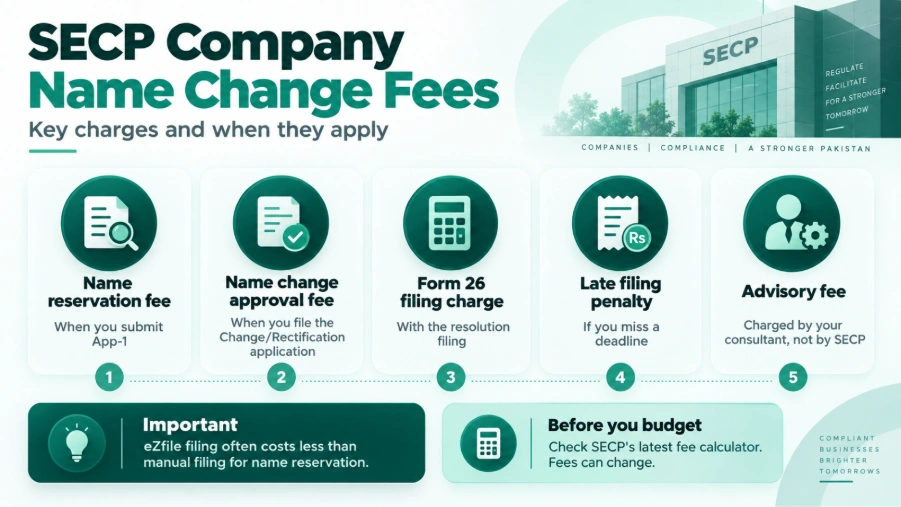
SECP’s fees follow its official fee schedule. They vary by company type and authorized capital. No single figure applies to every company.
Filing online through eZfile usually costs less than filing manually for the name reservation fee. The name change approval fee is separate from that reservation charge. Form 26 also carries its own statutory fee. Regulated companies may also face extra NOC-related costs.
SECP updates its fee schedule from time to time. So, check the current figures on SECP’s own fee calculator before you budget for the process.
SECP doesn’t guarantee a fixed timeline. So, treat any exact number you see online with caution. Speed depends on a few things. How quickly does your name get approved? How fast can you pull your documents together? How thorough is SECP’s review? Do any NOCs or observations slow things down?
The most common causes of delay are simple. Incomplete documents. Inconsistent spelling of the new name across your paperwork. Missing affidavits. NOCs that haven’t come through yet.
SECP has offered faster processing for certain filings in the past. Do you want to know whether a fast-track option currently applies to name changes? It’s best to confirm this directly with SECP or your advisor.
My company isn’t showing up in eZfile. This usually means your account isn’t correctly linked to your company profile. Or your filing authorization isn’t set up properly. Check your user role first. Still stuck? Contact SECP’s CRO helpline.
I can’t find the Change of Name option. This option appears only after SECP reserves your proposed name. Don’t see it? Go back and complete App-1 first.
My name is reserved, so why hasn’t it changed yet? This is the most common mix-up in the whole process. Reservation only holds your name. It doesn’t change it. You still need the resolution, Form 26, the Change/Rectification filing, and the altered certificate before your new name becomes official.
What if my name reservation expires? A reserved name only stays held for a limited period under the Companies Act, 2017. Does that window close before you finish the process? Then you’ll likely need to reapply. Check the current reservation period on SECP’s portal, since it can change.
An observation means SECP spotted a gap or mismatch somewhere in your application. You need to fix it before SECP can approve the change. This is a completely normal part of the process. It’s not a rejection.
Why does SECP raise one? A few common reasons: missing documents, a resolution that doesn’t clearly state the proposed name, a mismatch with your amended MOA or AOA, an incomplete affidavit, a missing NOC, incorrect data, or a payment issue.
Want to fix it? Look closely at exactly what SECP flagged. Prepare the correction. Upload it against the same application, then resubmit. Responding quickly keeps your overall timeline shorter.
You usually don’t need to start over. Most observations only require fixing the flagged issue. There’s one exception, though. Was your resolution fundamentally flawed, or has your name reservation expired? Then part of the process may need redoing.
A rejected name usually comes down to one of three things. It’s too close to an existing company name. It uses a restricted word, or it implies a government tie your company doesn’t have.
Here’s the good news: you can submit a fresh App-1 with a different name. There’s no real limit on how many times you can try. Just know that each attempt carries its own fee.
Do you genuinely believe SECP’s rejection was wrong? You can pursue SECP’s internal review or appellate options under the Companies Act, 2017. Confirm the exact appeal deadline directly with SECP. Regulations set these timelines, and they can change.
Getting the certificate isn’t quite the finish line either. You still have some follow-up work to do, and keeping on top of it is exactly the kind of ongoing task covered by statutory compliance services.
Section 13 of the Companies Act, 2017 covers this. Your company must display its former name alongside the new one. Do this for ninety days from the date SECP issues the certificate.
This rule doesn’t apply to an SMC or a private company. The exception? If that company is a public interest company, or a subsidiary of a listed company.
Your legal name on FBR records must match your updated SECP registration. But this update doesn’t happen automatically. Confirm the exact documents FBR needs directly with them, a step our guide to tax filing in Pakistan also touches on for ongoing FBR record accuracy.
Your bank will also ask for the altered certificate. They use it to update your KYC records under the new name. Start this early, since banks can take a while to process it, and our financial consultancy services can help coordinate this alongside your other financial updates.
Replace your letterheads, invoice templates, stamps, and signage. You can still use up any old stock while the 90-day rule applies. You’ll also need to update your website, email signatures, payment gateway details, and any online listings, so they match your new legal identity, work that often runs alongside broader outsourced accounting support once invoicing templates and records need reissuing.
Don’t forget any sector-specific licenses or registrations tied to the company. You’ll need to update these with the relevant regulator too.
No, and this is genuinely reassuring for most business owners. A name change doesn’t erase, transfer, or reset any of your company’s existing duties.
Contracts signed under your old name stay enforceable. Why? Because the company itself hasn’t changed, only its name has. It’s still good practice to notify the other parties and update references going forward.
Outstanding debts and liabilities carry forward exactly as they were. Just make sure to notify your lenders, so their records stay accurate. Court cases and legal proceedings continue against the same company too. They reflect the updated name from that point on.
Your CUIN (Corporate Universal Identification Number) stays the same. Why? Because your company is still the same registered entity. Your NTN generally doesn’t change either. A name change doesn’t make you a new taxpayer, in the same way SECP, FBR, and NTN registrations are treated as one linked set of records for freelancers and startups registering a business in Pakistan. You will still need to update the name on FBR’s record, though, so check the exact steps directly with FBR.
You typically won’t need a new bank account. Most banks update the account name and KYC details. They usually don’t ask you to open a new account, though this can vary slightly by bank.
Haven’t picked a new name yet? Start with SECP’s availability check and a quick trademark search before you commit.
Is your name already reserved? Move straight into drafting your special resolution before that reservation window closes.
Are you drafting the resolution right now? Make sure it clearly names both your current and proposed company names. It should also name someone to handle the SECP filings.
Stuck inside eZfile? Check that your account is properly linked to your company first, before assuming something’s broken.
Has SECP raised an observation? Respond to the exact point it flagged, rather than resubmitting your whole application.
Is your application already approved? Then your priority now is the ninety-day former name rule, your FBR updates, and your banking KYC. Don’t just file the certificate away and forget about it, and if this change is part of a wider rebrand or restructuring, our business development consulting team can help you plan the transition properly.
If you want professional support with the process, PFOC can assist with name reservation, resolutions, Form 26, eZfile filing, SECP observations, and post-approval compliance. Contact PFOC for clear guidance based on your company’s situation.
Yes, it can. There’s no limit on how many times a company can change its name, if each change follows SECP’s process properly.
That means getting the new name approved, passing the required resolution, and filing everything correctly. Before you start, double-check that the new name fits SECP’s naming rules, this saves you from delays later.
Yes, they do. Your share certificates show the company’s registered name, so any certificates issued after the change should carry the new name. It’s also a good idea to update your shareholder records and other company documents at the same time, so everything stays consistent.
Yes, you can. Plenty of companies’ trade under a brand name that’s different from their official registered name. Just remember your legal company name still needs to appear on official documents where it’s required. And if the brand name matters to your business, it’s worth protecting it separately through a trademark.
Yes. Once SECP approves your new name, it’s time to update your business documents, invoices, letterheads, receipts, quotations, all of it. One thing people often miss: if the 90-day former-name rule applies to you, you’ll need to show your old name alongside the new one during that period.
No, not yet. Reserving a name just means SECP has given you the green light to move to the next step, it doesn’t change your legal name. Your company’s name only officially changes once SECP approves the full application and issues the altered certificate of incorporation.
WhatsApp us