
Payroll Compliance Checklist in Pakistan: Salary Tax, EOBI, Social Security, Gratuity and Leave (2026)
Request a Free Quote
Introduction
Paying your staff in Pakistan is about more than just sending cash. You must manage two different worlds. First, you handle income tax for the federal government. Second, you deal with welfare payments like EOBI for the provinces.
There are new tax rates and rules you must follow. If you miss them, you could face legal trouble. This article guides you through all the steps. It will help you keep your payroll clean and your staff happy.
What Is Payroll Compliance in Pakistan?
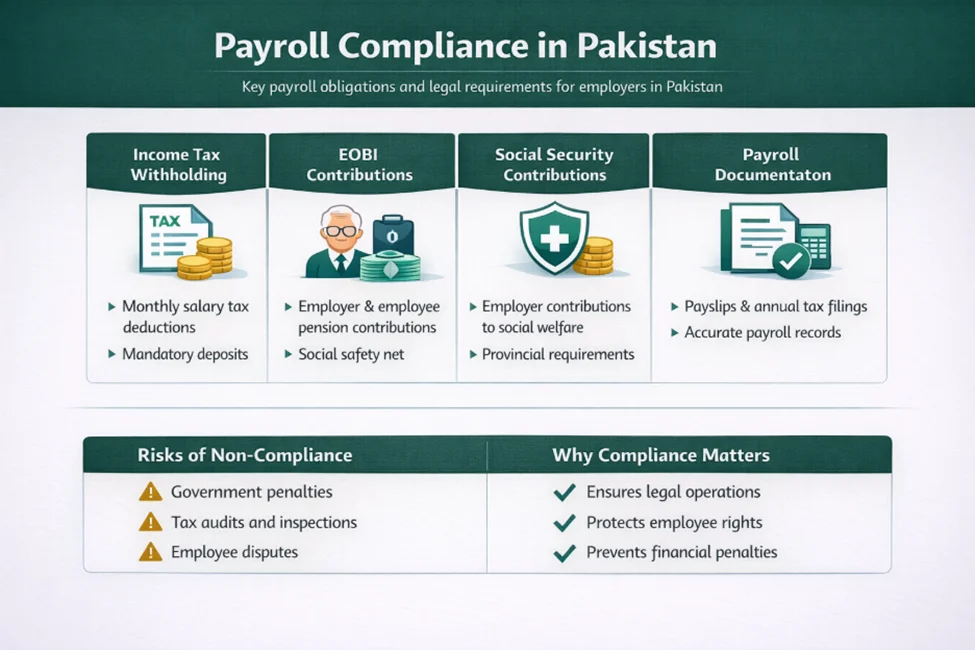
Payroll is the simple act of paying your team. Compliance is the hard part. It means every rupee you take out and every bit of tax you send must follow the law. The main laws are the Income Tax Ordinance of 2001 and provincial labor rules.
Think of compliance as a bridge. It connects your HR team to your Finance team. When both sides talk and follow the rules, your math stays legal. This keeps the “gross-to-net” pay correct for every worker.
How Federal and Provincial Rules Work Together
Pakistan uses two layers of rules. Income tax is a federal matter. The FBR (Federal Board of Revenue) runs that part. On the other side, labor welfare is mostly provincial. This includes EOBI and social security.
Your location changes who you pay. A company in Lahore follows PESSI rules. A company in Karachi follows SESSI rules. In KPK, you look to KPK-ESSI. In Balochistan, it is B-ESSI. You must know which board fits your business. Filing with the wrong one will lead to fines.
Why Compliance Matters Beyond Fines
Good compliance builds trust with your staff. When employees see their EOBI paid on time and receive a correct tax certificate, they feel secure. Secure staff stay longer.
If your business is seeking investment, clean payroll records are vital too. Investors check payroll during due diligence. Any gaps raise red flags. If you are starting a new business, the PFOC guide to starting a business in Pakistan covers the full compliance setup from day one.
The Most Common Mistakes
Most payroll issues happen because a business lacks a solid process. Here are the errors we see most often:
- Wrong Labels for Workers: Do not call full-time staff “contractors” to skip EOBI or social security. Inspectors look for this. If they catch you, the fines are huge and go back years.
- Using Old Tax Slabs: The FBR changes slabs every year. If you give a raise but forget to update the slab, you will hold back too little tax. Your company will then have to pay the gap.
- Late Filing: If you file your monthly paper late on the IRIS portal, you get hit with an automatic fine.
- Hiding Wages: Do not report only the basic pay for social security. You must report the total wages. If you don’t, you face underpayment fines.
The Payroll Process in Pakistan
Pre-Payroll Setup
Before you process a single salary, complete these registrations:
Register your company as a Withholding Agent on the FBR portal. This gives you IRIS access to file monthly statements under Section 149. Register your business and eligible employees with EOBI. Register with your provincial social security institution. Then set up your payroll system to comply with local tax rules.
Setup costs for a small or medium business usually range from PKR 75,000 to PKR 200,000. If you need to register your company first, the PFOC guide to registering a private limited company covers every step.
The Monthly Cycle
Each month, you follow the same steps. Collect attendance, overtime, and leave data. Calculate gross pay and apply current tax slabs. Calculate EOBI and social security deductions. Create a PSID and deposit withheld tax before the 15th. Then file statements on the IRIS, EOBI, and provincial social security portals.
Annual Tasks
At year’s end on June 30th, issue Form 16 certificates to all employees. Reconcile the total tax deposited against your monthly filings. Prepare your salary ledger in case the Commissioner of Inland Revenue calls for a review.
Salary Tax Withholding in Pakistan
The Legal Requirement
Section 149 of the Income Tax Ordinance 2001 is clear. Every employer must deduct tax from employee salaries. This is not optional. If you fail to do it, your company is liable, not the employee.
Always use the current year’s rates. Using outdated rates is one of the most common causes of under-withholding. For a broader view of how these taxes connect to your overall business fina PFOC guide to business taxes in Pakistan. nces, see the PFOC guide to business taxes in Pakistan.
A Simple Calculation Example
Let’s say a worker earns PKR 180,000 a month. Their yearly pay is PKR 2,160,000. This fits into the third tax slab.
- The base tax is PKR 6,000.
- The extra tax is 11% of anything over PKR 1,200,000.
- In this case, 11% of PKR 960,000 is PKR 105,600.
- The total yearly tax is PKR 111,600.
- The monthly tax to hold back is PKR 9,300.
Deadlines and Common Errors
You must pay the tax by the 15th of the next month. If you miss it, you face a 12% yearly fee plus a 5% fine for the first month. Common slips include forgetting to tax perks like cars or missing the tax on big bonuses.
EOBI: What You Need to Know
Who Must Register
Any business with five or more employees must register with EOBI. Even if your headcount later drops below five, the obligation stays.
The Contribution Rate
You pay EOBI based on the minimum wage. You do not use the actual salary. With the minimum wage at PKR 37,000, the total monthly cost is PKR 2,220 per person:
- Boss’s share: 5% of minimum wage (PKR 1,850).
- Worker’s share: 1% of minimum wage (PKR 370).
- Total: 6% (PKR 2,220).
Take the worker’s share from their pay. Pay both parts via the EOBI portal by the 15th. Use the PR-01 slip to do this.
Common EOBI Mistakes
The most costly mistake is calculating on actual salary instead of minimum wage. This causes overpayment. Always use minimum wage as the base. Also, do not stop contributions when an employee turns 60 unless they have completed the required 15-year contribution period.
Social Security: Provincial Rules
Which Institution Applies
- Punjab: PESSI
- Sindh: SESSI
- Khyber Pakhtunkhwa: KPK-ESSI
- Balochistan: B-ESSI
Each province has slightly different rules. Wage ceilings and registration thresholds can vary.
How Payments Work
The boss pays 6% of the wages. Workers pay nothing. There is a pay limit, usually near PKR 40,000. If a worker earns more, you only pay 6% on that limit. Payments are due by the 15th. Late fees can be 0.5% per day.
EOBI vs Social Security
| Feature | EOBI | Social Security |
|---|---|---|
| Benefits | Old-age pension, survivors' pension | Healthcare, disability, sickness pay |
| Who Pays | Employer and employee | Employer only |
| Contribution Base | Minimum wage | Up to the wage ceiling |
| Audit Frequency | Every 3 to 5 years | Annual or bi-annual |
Both are legal obligations. You cannot choose one and skip the other.
Gratuity: Rules and Calculations
Who Is Entitled
Gratuity applies to commercial establishments with 20 or more employees, and industrial ones with 50 or more. An employee must complete at least one full year of service to be entitled.
The Formula
(Last Drawn Gross Salary divided by 26) multiplied by 30 multiplied by Years of Service
Example: An employee earns PKR 100,000 and leaves after 5 years. (100,000 divided by 26) 30 multiplied by 5 equals PKR 576,923.
Tax on Gratuity
If your gratuity fund is not FBR-approved, the employee is exempt from the smaller of PKR 300,000 or 50% of the amount. If FBR-approved, the full amount may be exempt under the Second Schedule.
You do not need to offer both gratuity and a provident fund. If your provident fund employer contribution equals or exceeds the gratuity entitlement, you are compliant.
Leave Compliance and Leave Encashment Tax
Minimum Leave Entitlements
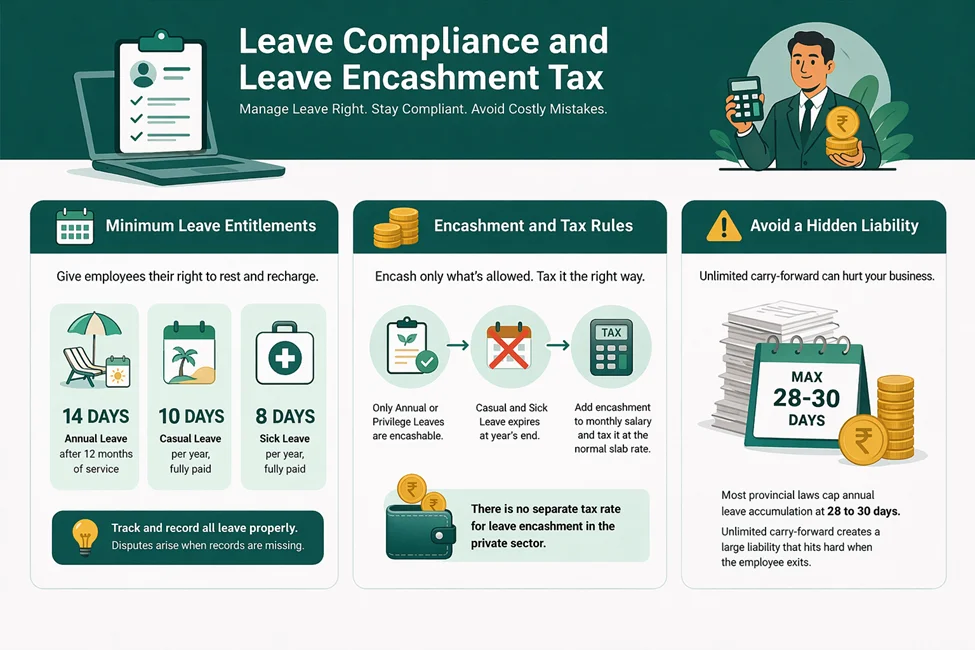
- Annual leave: 14 days after 12 months of service
- Casual leave: 10 days per year, fully paid
- Sick leave: 8 days per year, fully paid
Track and record all leave properly. Disputes arise when records are missing.
Encashment and Tax Rules
Only annual or privilege leaves are encashable. Casual and sick leave expires at year’s end. When you pay leave encashment, add it to the employee’s salary for that month and tax it at the normal slab rate. There is no separate rate for private sector employees.
Do not allow unlimited carry-forward of annual leaves. Most provincial laws cap accumulation at 28 to 30 days. Unlimited carry-forward creates a large liability that hits hard when the employee exits.
Penalties for Non-Compliance
Missed tax deposit: 12% per annum default surcharge plus a 5% penalty for the first month. The penalty grows each month you stay late.
EOBI non-compliance: A penalty equal to 100% of the unpaid contribution. Criminal proceedings are possible for willful failure to register employees.
Social security non-payment: Authorities can issue a distress warrant and seal your business premises until the debt is cleared.
Payroll Audit Requirements
What Inspectors Ask For
When FBR or EOBI sends an inspection team, they will request:
- Monthly salary sheets
- Bank transfer records proving payment
- Computerised Payment Receipts (CPRs) for all tax deposits
- Employee CNIC copies and appointment letters
Organise these records now, not when you receive a notice. For a full breakdown of FBR filing requirements, the PFOC tax filing guide for Pakistan explains the IRIS submission and annual reconciliation steps.
How Long to Keep Records
Keep tax records for six years. Keep EOBI and social security records for at least ten years. Authorities can claim arrears going back several years.
Your Internal Audit Questions
Ask yourself these regularly. Are all employees over 18 registered with EOBI? Does the total salary in your accounts match FBR filings? Are calculations using the current 2026 slabs? Do contributions reflect the correct provincial wage ceiling? If any answer is no, fix it before an inspector does.
Should You Outsource Payroll?
Outsourcing is often 40% cheaper than keeping a full in-house team. The cost ranges from PKR 300 to PKR 1,500 per employee per month, depending on volume and support level.
Look for a provider that offers a compliance guarantee. This means they take responsibility for the accuracy of your filings. If they make an error, they fix it.
If your business is growing fast or you have received an FBR audit notice, now is the time to act. PFOC’s financial consultancy services can take over your payroll immediately and prepare your audit documentation.
For early-stage businesses, PFOC’s startup consultancy covers payroll setup, labour law compliance, and tax registration from day one. If you also need support with FBR disputes or labour law matters, PFOC’s legal consultancy team handles both under one roof.
Complete Payroll Compliance Checklist
- FBR registration is active, and company is tagged as a Withholding Agent.
- Salary tax uses the current 2026 slabs from the Finance Act.
- Withheld tax is deposited before the 15th of every month.
- All eligible employees are registered with EOBI.
- EOBI contributions are paid by the 15th using the PR-01 slip.
- Business is registered with the correct provincial social security institution.
- Social security contributions are based on the current wage ceiling.
- Gratuity calculations use the 26-day divisor rule.
- Encashment is added to the salary and taxed at the standard slab.
- Salary sheets and CPRs are filed and stored.
- Records are kept for at least 6 years for tax and 10 years for EOBI and social security.
- Annual tax reconciliation is done by July 15th.
- Statutory challans are reviewed quarterly.
How PFOC Helps Pakistani Businesses Stay Compliant
Payroll compliance in Pakistan changes every year. New Finance Acts bring new slabs. Provincial wage ceilings shift. FBR updates its file formats. Keeping up with all of it is a full-time job.
PFOC manages your entire payroll cycle. This covers gross-to-net calculations, monthly IRIS filings, EOBI and social security payments, and full audit documentation. When you operate in multiple provinces, PFOC tracks the different rules for PESSI, SESSI, and KPK-ESSI, so you do not have to.
For a fuller picture of your business tax position, the PFOC guide to corporate tax in Pakistan is a useful resource to read alongside this one.
Contact PFOC today for a full payroll health check.
Conclusion
It’s not just about avoiding a letter from a tax officer; it’s about making sure your workers get the pension and healthcare they are owed.
Laws change all the time, especially with the new updates; you can’t just set your system and forget it. Keep your paperwork ok and make sure every payment is made by the 15th of the month.
FAQS:
Yes. If their total annual income exceeds PKR 600,000, tax applies regardless of contract type.
By the 15th of the following month. You pay using the PR-01 slip on the EOBI portal.
Generally yes. The 15th is standard across PESSI, SESSI, KPK-ESSI, and B-ESSI.
Nothing. Gratuity only becomes a legal right after 12 months of continuous service.
Yes. Add the bonus to the employee’s estimated annual income and recalculate the slab. Spread the extra tax across the remaining months to avoid a large one-time deduction.
Yes. EOBI is tied to your registered establishment, not the work location. All employees must be enrolled regardless of where they work.
Yes, if your employer’s contribution to the provident fund equals or exceeds the gratuity entitlement. You do not need to offer both.