
SECP Company Registration Online in Pakistan: Step by Step Guide
Request a Free Quote
Introduction
Your name has just been approved. The certificate is on its way. You feel like you’ve crossed the finish line.
You haven’t.
That’s the number one mistake people make with SECP company registration. They treat the registration certificate as the end. It’s the start. Miss the steps that follow and you’ll face bank account blocks, FBR fines, and SECP fines before you earn your first rupee.
This guide covers the full process. From setting up your account to what you must do in the first 30 days after you register.
What SECP Does (and What It Doesn’t)
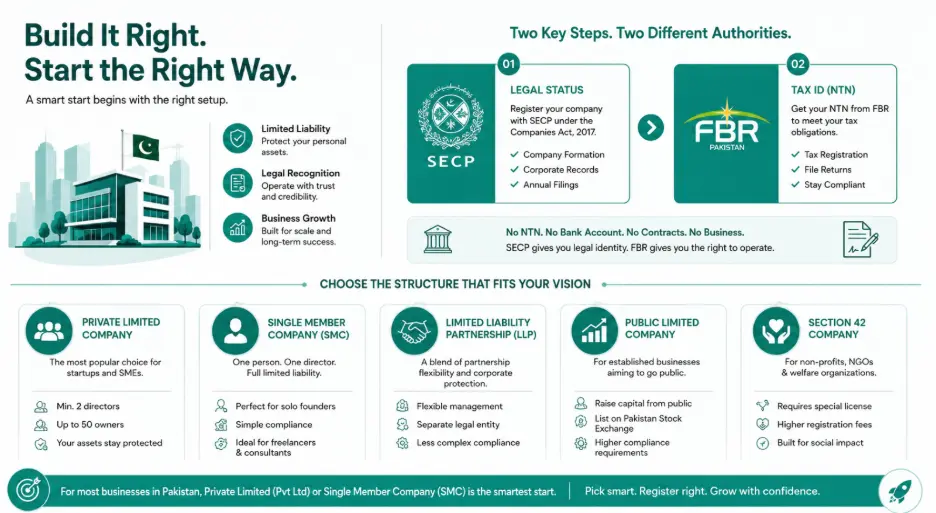
SECP registers companies under the Companies Act, 2017. It handles company formation, corporate records, and yearly filings.
It does not handle taxes.
Register Your for Company with Confidence
That’s the FBR’s job. You need both. SECP gives your company legal status. FBR gives you a tax ID. Without an NTN from FBR, no bank will open a corporate account for you. You can’t file returns or sign most formal contracts either.
Keep this in mind as you go. Your SECP filing is step one in a longer chain.
Which Company Type Should You Pick?
This is your first real call. It shapes your docs, fees, yearly duties, and how you pay tax.
Under the Companies Act, 2017, you have these main options:
Private Limited Company (Pvt Ltd): The most common choice for startups and SMEs. You need at least two directors. Owners are capped at 50. Your own assets stay safe from business debts.
Single Member Company (SMC): One person, one director, full limited risk. Great for solo work. Business registration for freelancers and startups often fits best with this structure.
Limited Liability Partnership (LLP): A mix of partnerships and a company. Good if you want a more flexible setup without full corporate rules.
Public Limited Company: For large firms that plan to list on the Pakistan Stock Exchange. Not the right fit for most new ventures.
Section 42 Company (Non-Profit): For NGOs and welfare bodies. Comes with a higher fee and a licence you must apply for separately.
For most people in Pakistan, Pvt Ltd or SMC covers the job. Our completeguide to starting a business in Pakistan covers how to pick the right fit for your goals.
How to Set Up Your eZfile Account
SECP moved all filings to the eZfile portal (also called LEAP) in 2024. The old eServices system is being phased out.
Here’s what most people miss: each director and owner needs a separate eZfile account. You can’t share one login.
To create an account: go to the SECP eZfile site. Click sign up. Enter your name, father’s name, address, CNIC number, phone, and email. SECP sends a code. Enter it. Your account is live.
Your CNIC or passport number is your login ID. SECP also sends a 4-digit PIN to your phone and email. This PIN acts as your digital sign. Save it. If you lose it, you can reset it via your profile page, but that takes time you may not have.
Set up an account for each director and owner before you start the main form.
Name Search: Where Most Filings Stall
More filings get blocked at the name step than at any other point. The good news? It’s the most fixable problem.
Your name must be unique. It can’t be the same as, or too close to, a company that’s already registered. SECP also blocks certain words outright.
You can’t use “Bank,” “Insurance,” “Trust,” or “University” without a licence from the right body. Words like “National,” “Federal,” or “Pakistan” need SECP’s prior nod. Use them without it and your filing is rejected.
SECP asks for three names in order of choice. Give each one real thought. Each name should match your main line of work.
Before you file, run the SECP company name search on their site. It’s free. But don’t stop there. Also check the IPO Pakistan database for trademarks. A name can pass the SECP check and still clash with a registered mark. That creates legal risk later.
Once approved, your name is held for 60 days. You must wrap up the full filing in that window or the hold expires. You’ll have to apply again and pay the fee a second time.
The name hold fee online is Rs. 1,000 (updated November 2024).
Get Your Docs Ready First
Gather these before you open the portal. Uploading unclear or partial scans is one of the main causes of a SECP query notice.
For each director and owner, you need:
- CNIC copies (both sides, clean scan) or a valid passport for foreigners
- Father’s name, home address, phone number, and email
For the company itself:
- Registered office address with proof (utility bill or rent agreement)
- MoA: outlines your company’s goals and main work
- AoA: sets out internal rules and director roles
eZfile builds draft MoA and AoA forms for you when you start. For most standard firms, the built-in templates work fine. If your work is in a licensed field, like health, education, or finance, you also need a NOC from the relevant body. SECP won’t process your filing without it.
Scan at 300 DPI minimum. Keep file sizes small. Large PDFs cause upload timeouts on the portal.
The Step-by-Step SECP Registration Process
Here’s how the process runs from start to cert:
Step 1: Create accounts for all directors and owners. Each account must be live before you touch the main form.
Step 2: Pick your filing route. eZfile gives you two paths: “Combined” (name hold and registration in one go) or “Separate” (name first, then registration later). Most people choose Combined to save time.
Step 3: Fill in the form. Enter your company name, office address, main business type, share capital amount, and all director and owner details. Add each person’s share percentage.
Step 4: Upload your docs. MoA, AoA, CNIC copies, and address proof. Check each file before you upload.
Step 5: Get digital signs from all directors. Before you can submit, each director must sign the form with their 4-digit PIN. Log into each account and complete the sign step one by one.
Step 6: Submit and pay. After signing, the portal creates a payment slip. Pay online via bank transfer, card, or mobile wallet. Keep your receipt.
Step 7: Wait for SECP to review. For online filings, SECP normally takes 1 to 3 working days when all docs are clean and the name is free.
Step 8: Get your cert. SECP emails you the registration cert and your CUIN. Download both from your eZfile dashboard right away.
For a full breakdown of the docs and share structure needed for Pvt Ltd firms, see our guide on how to register a private limited company.
What Does SECP Registration Cost?
Fees depend on your share capital and how you file. Online is always cheaper.
Here’s a rough breakdown for 2026:
- User sign-up fee: Rs. 200 per person (one-time, per eZfile account)
- Name hold fee (online): Rs. 1,000
- Registration fee (online): From Rs. 1,750 for capital up to Rs. 100,000
For a Pvt Ltd or SMC with base capital of Rs. 100,000, your total government fees online come to roughly Rs. 2,200 to Rs. 2,500. Consultant fees and legal drafting costs are on top of this.
The fee goes up with your share capital. SECP uses a tiered slab system. More capital means a higher base fee, but the rate drops on each extra slab. Use the SECP fee tool on their site to get an exact figure for your amount.
Note: SECP updated its fee table in November 2024. Always check the live rates on the official SECP site before you file. Our expert guide to company registration in Pakistan covers the full fee breakdown.
How Long Does It Take?
Online filings via eZfile normally take 1 to 3 working days when docs are complete and the name is clear.
Manual filings at a physical SECP office take 5 to 10 working days. SECP has offices in Islamabad, Karachi, Lahore, Peshawar, Quetta, Multan, Faisalabad, and Gilgit.
One query notice from SECP resets your clock. A name block does the same. The only way to stay in control of your timeline is to prepare everything before you start.
After the Cert: Your First 30 Days
This is where most guides stop. It’s also where most new companies fall behind.
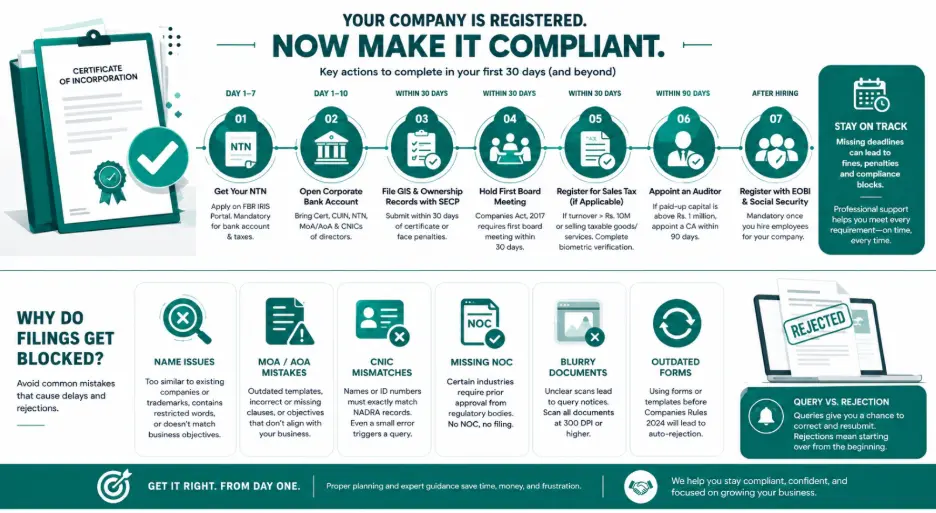
Your cert proves your company exists as a legal entity. It does not make you tax-ready, bank-ready, or fully legal to trade. Here’s what you must do right away:
Get an NTN from FBR. Apply through the FBR IRIS portal. You’ll need your cert and director CNIC copies. No NTN means no bank account. It’s not optional.
Open a corporate bank account. Take your cert, CUIN, NTN, MoA/AoA, and director CNICs to your bank. If any director is a non-citizen, allow extra time for the bank’s checks.
File your GIS and ownership records with SECP. You must do this within 30 days of getting your cert. Miss this date and you’ll face fines.
Hold your first board meeting. The Companies Act, 2017 sets a 30-day window for this from the date of registration.
Register for sales tax (if needed). If your yearly sales will top Rs. 10 million, or if you sell taxable goods or services, you need an STRN. Complete the biometric check within 30 days to stay on FBR’s active tax list.
Appoint an auditor. If your paid-up capital is above Rs. 1 million, you must appoint a chartered accountant within 90 days of registration.
Register with EOBI and local social security. This kicks in once you hire staff.
Annual compliance services for registered companies help you track each of these dates so nothing gets missed.
Why SECP Blocks Filings
Most blocks trace back to the same short list of mistakes:
Name problems. A name too close to an existing firm or trademark. A name with blocked words used without approval. A name that doesn’t match your stated business type.
MoA and AoA errors. Using an old template. Business goals that don’t match your stated line of work. Missing or wrong clauses.
CNIC mismatches. Names and ID numbers on the form must match NADRA records exactly. One letter off and you get a query notice.
Missing NOC. Licensed fields need prior sign-off from the sector body. SECP won’t process your filing without it.
Blurry scans. Poor quality documents trigger query notices. Scan at 300 DPI minimum.
Outdated forms. SECP issued new Companies Rules in 2024. Any template from before that date causes auto-rejection.
If SECP sends a query letter, you get a chance to fix and resubmit. A full rejection means starting over. Our legal consulting services in Pakistan help you get the filing right the first time.
Your Duties After Registration
Registration is not a one-time event. Once you’re registered, you have duties that repeat each year:
- File a yearly return with SECP within 30 days of your AGM
- Submit audited accounts within the window set by SECP after your year-end
- File monthly withholding tax and yearly income tax returns with FBR
- Tell SECP within 15 days if any director, owner, or office address changes
Late filings mean rising fines. Repeated non-compliance can lead to show-cause notices and director liability. In serious cases, your company can be struck off. Expert tax planning services in Pakistan keep you ahead of each deadline year-round.
Ready to Register?
SECP company registration online is faster and more open than it’s ever been. But it rewards prep work and punishes shortcuts.
If you want it done right on the first try, PFOC handles the full process: name hold, doc prep, eZfile filing, and post-registration compliance. We also cover FBR registration and yearly filings so you’re not chasing deadlines across two bodies on your own.
Our startup consulting help in Pakistan is built for exactly this: getting your company registered and compliant from day one.
Contact PFOC today and get your company registered without the guesswork.
FAQS
Yes. A Single Member Company (SMC) lets one person form a company. That same person must also act as director.
Yes. Non-citizens can be directors or owners. They need valid passport copies in place of CNICs. They must also get an NTN from FBR after registration. Some fields need extra Board of Investment approval.
Rs. 100,000. This is the base on which your SECP fee is worked out. You can set it higher if your business needs it.
No. eZfile lets you do it yourself. But if you have non-citizen owners, work in a licensed field, or need a custom MoA/AoA, expert help cuts the risk of rejection.
Authorized capital is the max your company can issue in shares. Paid-up capital is what owners have actually put in. Your SECP fee is based on authorized capital. It must always equal or exceed paid-up capital.
The name goes back into the pool. Anyone can take it. You must apply again and pay the hold fee a second time. Don’t let the 60-day window close.
For a standard Pvt Ltd or SMC with minimum capital, expect around Rs. 2,200 to Rs. 2,500 in government fees for online filing. Use SECP’s fee tool for exact figures based on your capital amount.