
- Home
- About Us
- Services
- Our Team
- Dubai
- Blog
- Contact Us
 Business Development Services
 Tax planning Services
 Accounting Services Pakistan
 Financial Consultancy Services
 Statutory Compliance Services
 Investment Consulting Services
 Digital Marketing Services
 Call Centre Compliance Services
 Managed IT Support Services
 Legal Consultancy Services
 Event Management Services
 Performance Marketing Services
 Compliance for Software Houses
 FBR POS Integration & Invoicing
Advantages of Outsourcing Payroll Services in Pakistan (2026 Guide)
Request a Free Quote
Introduction
Manual payroll systems are now a real risk for most firms. The FBR uses AI audit tools. Local tax bodies now share their data with each other. There is little room left for errors in how you pay your staff. Monthly payroll is no longer just a back-office task. Done wrong, it can damage your compliance record fast.
In the past few years, top firms have changed how they handle this. Leaders no longer ask whether to outsource payroll. They now see it as the best way to cut risk. This guide shows why so many firms, especially those with teams across both the UAE and Pakistan, now rely on expert financial consultancy services to run the process properly.
What Is Payroll Outsourcing in Pakistan?
Payroll outsourcing in Pakistan means you hand the full salary cycle to a third-party firm. It goes beyond just running numbers. The firm also handles tax filings, legal payments, and local social security under one roof.
In 2026, most firms use cloud-based tools for this. You stay in full control and can check things in real time. The provider deals with tax rules, data, and compliance based on their deep knowledge of Pakistani law.
How Does the Payroll Process Work in Pakistan?
The payroll process in Pakistan is complex. The country has a multi-tier tax setup. Firms must follow both federal income tax rules and local social security laws. The process runs on a four-week cycle:
- Data Input: Collect hours worked, overtime, bonuses, and expense claims.
- Tax Calculation: Apply the latest Finance Act tax bands and local caps for EOBI and SESSI/PESSI.
- Bank Payment: Create SIF files so salaries hit accounts by the 1st of each month.
- Filing: Send digital pay slips and submit monthly tax statements to the FBR.
In-House vs. Outsourced Payroll: What Is the Real Difference?
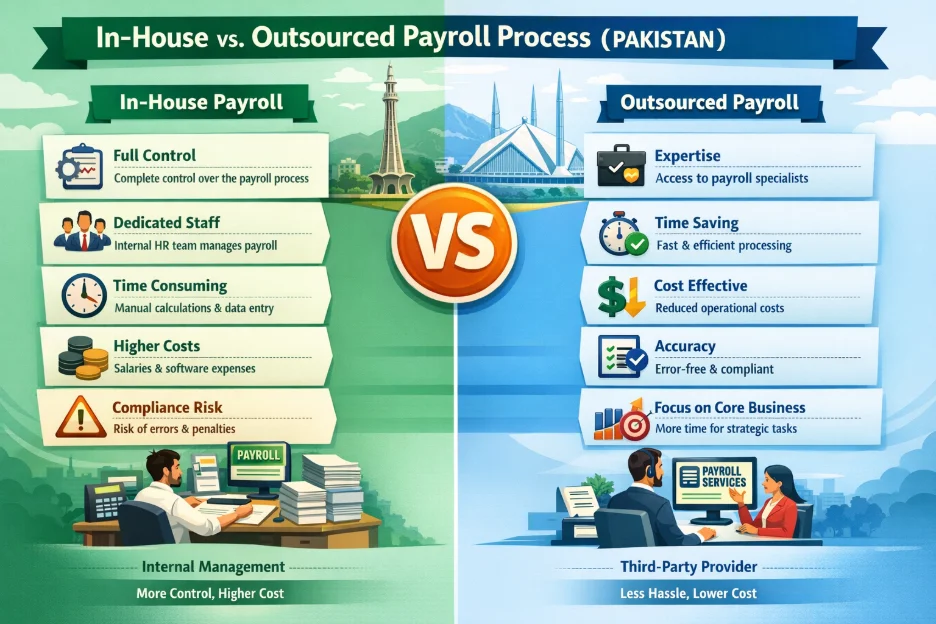
The choice between in-house and outsourced payroll affects every part of your firm. It helps to know both sides clearly before you decide.
In-House Payroll
Most in-house vs. outsourced payroll debates start with a false sense of control. When you keep it in-house, one person often updates the data by hand. That feels safe because they are right in your office.
But this creates a real risk. If that person leaves or falls sick, all the key data goes with them. You can miss tax due dates fast. Most internal teams are also too busy to track every new FBR rule change. A small error can quickly turn into a big compliance problem.
Outsourced Payroll
When you outsource salary processing, the work runs to a set standard. The firm uses proven systems built on the latest tax rules. The work does not rely on one person. Whether it is a public holiday or a staff member is off, the payroll runs on time.
This gives you a level of expert review that internal teams can rarely match without a large spend on training.
Advantages of Outsourcing Payroll Services in Pakistan
The advantages of outsourcing payroll services go far beyond saving admin time. They protect your firm’s finances and legal standing too.
How Much Can You Save by Outsourcing Payroll?
Most firms are surprised by the savings once they stop running payroll in-house. Add up the salary of a full-time payroll officer, software licence fees, desk space, and the cost of training every time a tax rule changes. The total is usually 20 to 30% more than what you would pay for professional payroll and financial consultancy services.
You trade a large, fixed monthly cost for one clear fee based on how many staff you have.
How Does Outsourcing Ensure Payroll Compliance in Pakistan?
Payroll compliance in Pakistan is the top reason firms outsource in 2026. The government now tracks every rupee paid to staff. Expert firms apply the right 2025-26 tax bands and avoid the common error of taking too much or too little tax. That kind of mistake leads to staff complaints or FBR audits. Working alongside PFOC’s tax planning services ensures your payroll and tax positions stay aligned at all times.
How Does Outsourcing Reduce Payroll Errors and Penalties?
Payroll penalties in Pakistan can do real damage to your firm. A missed tax deadline or wrong social security payment is not a minor issue. It can mean large fines or even frozen bank accounts. When you outsource, auto checks keep all filings correct. Meeting your statutory compliance obligations for EOBI, SESSI, and PESSI becomes a managed process rather than a monthly risk.
How Much Time Does Outsourcing Save Your Team?
Outsourcing payroll frees your HR team from the monthly grind. Instead of spending 40 hours on data entry and tax math, they can focus on what really matters. That means building talent, keeping top staff, and creating a place where people want to work.
Payroll Accuracy, Audit Readiness, and Reporting
A payroll audit in Pakistan can come at any time. When a third party manages your records, you are always ready. Every figure has a full audit trail. All required payment receipts are filed and stored in order. This works hand in hand with proper bookkeeping services in Pakistan, which ensure your accounts and payroll records stay consistent for any SECP-mandated external audit.
How Secure Is Your Payroll Data with an Outsourced Provider?
Pay data leaks cause real tension at work. Salaries are private. Under proper payroll data security rules in Pakistan, all data is encrypted and only shared with those who need it. This stops salary talk from spreading around the office and keeps your firm’s finances private.
What Are the Risks of Payroll Outsourcing?
The benefits are clear, but the risks of payroll outsourcing are real, too. The main concern for most firms is losing direct oversight. Fix this by choosing a provider that gives you a live dashboard so you can see all activity at any time.
Data privacy is also a valid concern. Choose a partner that meets ISO 27001 standards and has a solid backup plan. Build in proper safeguards so you never have to guess what is going on.
Payroll Software vs. Outsourcing: Which Is Right for You?
The choice between payroll software and outsourcing is a build-vs-buy call. Software gives you tools. Outsourcing gives you the skill to use them right. In Pakistan, tax rules change often through SROs. Software alone is not enough. You still need an expert to set it up each time the rules change. Outsourcing pairs good tech with skilled tax experts in one service.
In-House vs. Outsourced Payroll: Comparison
Feature | In-House Payroll | Outsourced Payroll (PFOC) |
Tax Knowledge | Basic / Out of Date | Expert / Current |
Technology | Excel / Local Tools | Cloud / AI-Enabled |
Risk of Penalties | High (Human Error) | Zero (Auto Checks) |
Staff Support | Slow / Manual | Self-Service Portal |
Audit Readiness | Days of Prep | Instant / Real-Time |
What Is on a Pakistan Payroll Outsourcing Checklist?
A smooth move to outsourced payroll starts with the right prep. Use this checklist to stay on track.
Before You Start
- List all current staff perks and pay types.
- Pull the income tax payroll data in Pakistan for this fiscal year.
- Check all staff have valid CNICs and are on NTN records.
Choosing a Provider
- Check they know local labour laws for each province.
- Make sure they are a good fit for your sector, whether tech, retail, or manufacturing.
- Ask for their data backup and security certificates.
After You Go Live
- Run the first outsourced payroll against last month’s in-house run.
- Check all monthly payroll processing receipts in Pakistan appear on the FBR and EOBI portals.
How Long Does Payroll Outsourcing Take to Set Up?
The payroll outsourcing timeline runs between 6 and 10 weeks, based on firm size.
- Weeks 1 to 3: Gather data and map out all pay types.
- Weeks 4 to 6: Run both the old and new systems side by side to check accuracy.
- Week 7: Link bank APIs for auto salary payments.
- Week 8 onward: Go live and shut down the old manual process.
Can Small Businesses in Pakistan Benefit from Payroll Outsourcing?
Many people think outsourcing is only for large firms. That is not true. Small business payroll in Pakistan is one of the fastest-growing parts of this market. For a startup or SME, hiring a full-time senior tax expert is often too costly. Outsourcing gives a small firm the same level of HR payroll and financial consultancy support as a Fortune 500 company, but at a much lower cost.
How Do You Choose the Best Payroll Service in Pakistan?
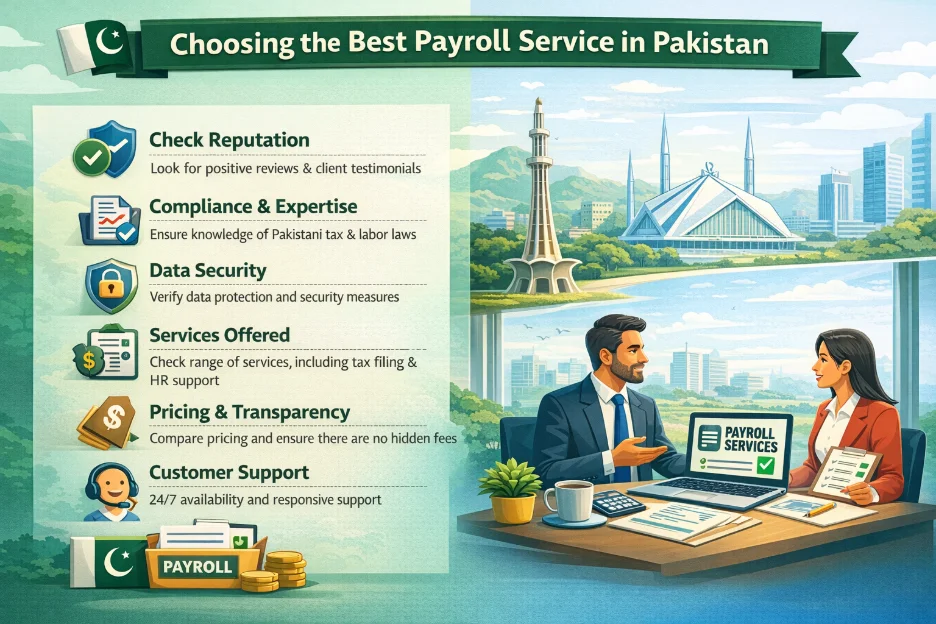
When you look for a payroll service near you, skill and tech matter more than location. The best firms in 2026 offer apps where staff can download their own tax forms and pay slips. When you assess payroll services in Pakistan, look for a compliance-first approach. A strong provider tells you about new rule changes before you see them in the news.
What Are the Common Myths About Payroll Outsourcing?
One myth is that outsourcing feels cold and distant. In fact, modern payroll services in Pakistan give better staff support than most small in-house teams. Another myth is that you lose control of your money. You do not. You keep full sign-off at all times. The provider builds you a clean, correct file to approve. Nothing goes out without your say.
How PFOC Can Help with Payroll Outsourcing in Pakistan
PFOC is more than a service firm. We act as your compliance partner and help you stay on top of the 2026 tax rules with ease. Our clients use the full advantages of outsourcing payroll to grow their business while we handle payroll tax filing in Pakistan and all legal payments. Our financial consultancy team covers payroll, bookkeeping, annual accounts, and tax support under one roof. Our Zero-Penalty Guarantee gives you the peace of mind to run your business well in a complex market like Pakistan.
Conclusion
The case for outsourcing payroll in 2026 is clear. Whether you want to cut costs or stay fully compliant, letting experts run the process is the smart move for any mature business. Whether you are a local SME or a UAE firm with a team in Pakistan, making your payroll process professional is the best way to protect your firm and your people. It turns a monthly headache into a background task that just works.
Want a free Payroll Health Audit? Contact the PFOC team today and we will find your compliance gaps and show you where to save money.
FAQS:
Expect to pay between 1,500 and 4,500 PKR, roughly $5 to $15 USD, per person per month. The price varies based on staff count and how complex their pay and benefits are.
Yes, it is fully above board. Most UAE firms use an Employer of Record or Managed Payroll model. This lets you pay Pakistani staff the right way, with all taxes sent to the FBR on time, so no one faces a surprise audit. PFOC also offers dedicated accounting services for overseas Pakistanis and UAE-based firms to make cross-border compliance straightforward.
A good provider handles all of it: monthly FBR tax, old-age benefits through EOBI, local social security through SESSI or PESSI, and small items like the education cost. Your staff also gets their yearly tax forms with no chase needed from you.
As noted in the payroll outsourcing timeline section, setup takes 4 to 8 weeks. This includes a parallel run month to confirm full accuracy before you go live.
You need your company NTN, SECP papers, staff CNICs, bank details, and your current pay breakdown policy.
Yes. Many firms now offer split payroll. The base pay stays in PKR to meet local rules. Bonuses or set rises can be pegged to AED or USD.
It comes down to cost and talent. UAE firms with remote tech or back-office teams in Pakistan gain from a cost gap of up to 5 to 1. Outsourcing lets them pay their Pakistani teams right, stay compliant with the FBR and EOBI, and skip the cost of setting up a local office.
he process follows the tax bands in the Finance Act. For 2025-26, the first 600,000 PKR is tax-free. Rates then rise from 1% up to 35% for high earners.
The main payroll outsourcing risks are picking a provider with no local tax know-how or one with weak data security. Vet each provider on these two points and you cut most of the risk.
Outsourcing to a Pakistani provider is roughly 70% cheaper than keeping a payroll desk in Dubai. The main reasons are lower labour costs and the exchange rate.
Yes, this is a core part of the service. Providers create monthly payment receipts and make sure all payments go out before the 15th of the next month.
Standard SLAs include 99.9% accuracy, same-day replies to staff queries, and a pledge to cover any fines caused by provider error.
You need a clear payroll outsourcing checklist, a project lead on your side, and at least one month of parallel runs to test the new system before you shut down the old one.
You avoid payroll penalties in Pakistan for late FBR filings, not being on the EOBI books, and wrong local social security payments.
Top firms use 256-bit encryption, the same level banks use, and store data in ISO-certified centers. Pakistan’s new Personal Data Protection Act in 2026 sets strict legal rules for financial personal data. Security is now tighter than it has ever been.