
Business Budget Planning in Pakistan: A Monthly System That Actually Gets Used
Request a Free Quote
Introduction
Most Pakistani businesses write a budget once a year. Then they forget it exists.
The finance manager pulls it out in December. By then, the numbers are six months old. The market shifted. The dollar moved. A key supplier changed prices. No one knows how far off the business ran.
This is a common issue. It is the standard experience for small and mid-size firms across Karachi, Lahore, and Islamabad. The budget gets filed. Operations continue by gut feel. Year-end results catch everyone off guard.
The good news? A simple monthly budget and review system fixes most of this. You do not need expensive software. You do not need a massive finance team. You need a clear process and discipline to run it every month.
This post walks you through exactly how to do it.
What Is Budgeting in Business?
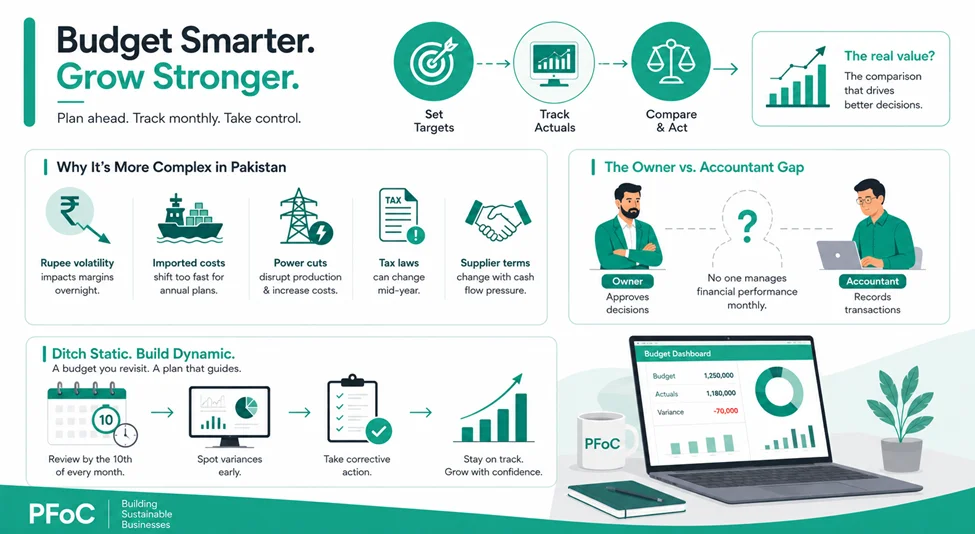
It means planning your income and expenses before the month begins. You set a target. You track what actually happens. Then you compare the two.
That comparison is where the real value lives.
Why Standard Advice Fails Here
In Pakistan, budgeting has extra layers of complexity. Generic financial advice ignores these factors:
- The rupee drops in unpredictable ways.
- Costs for imported goods shift too fast for annual plans.
- Power cuts disrupt production schedules and raise costs.
- Tax laws change mid-year without warning.
- Supplier payment terms change based on cash flow pressure.
The Owner vs. Accountant Gap
Many Pakistani SMEs operate without a dedicated finance leader. The owner handles approvals. An accountant posts entries. No one sits between them to manage financial performance each month.
This is why a static annual budget fails. Annual budgets are a useful starting point. But without a monthly review system on top, they become decorative paper. You need something you will actually use.
Budgeting here means building something dynamic. Something your team revisits. Something that tells you, by the 10th of every month, whether you are on track.
The Four Budgeting Steps: Build It Right
Before you worry about reports, build the budget correctly. A weak budget produces meaningless comparisons.
Step 1: Start With Revenue
Break your sales into categories. Do not budget a single total figure. If you sell three product lines, budget each one separately. If you have service retainers and project work, separate those, too.
Ask yourself:
- What did we achieve last year in each area?
- What changed in the market since then?
- What is realistic, not optimistic, for the next year?
Work in monthly figures. Revenue in Pakistan rarely falls evenly across 12 months. A trading firm sees spikes around Eid, construction season, or import cycles. A B2B firm might have quarterly billing patterns. Your budget format must reflect the actual rhythm of your business, not a flat line.
Step 2: Map Your Costs Into Three Buckets
Separate costs into three categories: fixed, variable, and semi-variable.
- Fixed costs stay the same most of the time. Like rent, permanent salaries, loan payments, and internet bills. These are predictable. Budget them accurately and review them only when things change structurally.
- Variable costs move with sales volume. This includes raw materials, packaging, commissions, and freight. Budget these as a percentage of revenue, not a flat amount. If sales go up 20%, these costs should move at the same rate.
- Semi-variable costs sit in the middle. This includes utility bills, overtime, temporary staff, and repairs. These require some judgment. Look at old patterns to build realistic ranges.
This split matters because variance analysis means different things for each bucket. A spike in fixed costs is a red flag. A rise in variable costs alongside higher sales is normal.
Step 3: Build a Cash Flow Budget
A profit budget and a cash flow budget are not the same thing. Many local small firms learn this the hard way.
You can show a paper profit and still run out of cash. This happens when customers delay payment. It happens when you pay suppliers before you collect from clients. It happens when a large tax bill lands in a month you did not plan for.
Build a simple monthly cash flow budget beside your profit budget.
- Show expected inflows by collection date, not invoice date.
- Show outflows by the date you actually pay them.
- Track the opening and closing cash balance for each month.
If any month shows a negative closing balance, you have a cash flow problem to solve before the month arrives. This is vital in Pakistan’s payment culture, where 60 to 90-day collection cycles are common.
Step 4: Include a Tax and Compliance Budget
Tax compliance carries real financial costs in Pakistan. Advance income tax, withholding tax deductions, sales tax, and FBR filing fees all impact cash.
Your budget must account for these. Estimate your advance income tax by quarter. Insert them into the cash flow budget on the right months. Budget for your annual external audit if required. Include the cost of your tax advisor or finance outsourcing partner.
Ignoring tax planning is a common budgeting mistake. The advance tax demand arrives. The return deadline is approaching. Cash meant for operations disappears tax planning for Pakistani businesses instead. If you want to understand these duties month by month, PFOC’s guide to lays it out clearly.
A Simple Monthly Budget Format
Your monthly budget format does not need to be complex. It needs to be usable. A practical monthly format has two main sections.
1. The Profit and Loss Section
This shows revenue by category, then direct costs. Below is the gross profit. Next are operating expenses split by fixed, variable, and semi-variable parts. Then comes operating profit, financing costs, tax provisions, and net profit for the month.
2. The Cash Flow Section
This section shows collections from customers. It shows payments to suppliers, staff, tax units, and lenders. It also tracks any machinery or asset purchases, ending with your cash balance.
That is it. Two sections. One page per month. A business does not need 40 spreadsheet tabs. It needs a format that its owner will open on the 5th of every month without dread.
Keep it in Pakistani Rupees. Do not mix currencies in the main format unless you genuinely transact in multiple currencies as a core part of your business.
How to Run the Monthly Review Meeting
Review this format in a short monthly meeting. Thirty minutes is enough if the numbers are ready. The meeting is not for entering data. It is for understanding what the data says.
Prepare the numbers before anyone enters the room. Distribute the report at least a day early. The meeting should focus on three questions:
- What happened?
- Why did it happen?
- What do we do differently next month?
That simple routine is worth more than any complex software your rivals use.
Variance Analysis: The Part Most Firms Skip
Once the month ends, you run the comparison. This is the variance analysis report.
What the Report Contains
You take each line in your budget. You put the actual number beside it. You calculate the difference. Then you write one sentence explaining why the difference exists.
That last part is what most firms skip. They look at numbers and move on. Nothing changes next month.
Why the Explanation Is Everything
The written note is the whole point. It forces someone to think. It creates a record your business can refer back to. It builds company knowledge. It tells you whether the variance was a one-off event or a permanent shift in your costs or sales pattern.
How to Read Variances Correctly
Not all positive variances are good. Not all negative variances are bad news.
A positive revenue variance might mean you landed an unexpected order. That is fine. It might also mean your team sold items with heavy discounts that crushed your margins. That is a problem, even if total sales look high.
An unfavorable cost variance might mean a supplier raised prices permanently. You now need to change your prices or find a new vendor. Or it might mean one month had a rare repair bill that will not repeat. The response to each situation is completely different.
The goal of tracking budget vs. actual figures is not to celebrate or punish. The goal is to understand what happened and use that knowledge to make better choices next month.
Common Variance Causes in Pakistan
Certain patterns repeat across Pakistani businesses once you track them seriously:
- Utility cost variances spike during power-cut seasons.
- Generator fuel costs are tough to predict and often underbudget.
- Import-heavy firms face raw material cost spikes whenever the rupee drops.
- Firms selling to government units face cash flow gaps when payments arrive months late.
- Retailers see massive sales swings around Eid and school seasons.
Understanding these patterns makes you better at forecasting. It also makes your explanations credible to owners, banks, or auditors. A good variance log also sharpens your next annual budget. When you have a year of notes, you stop repeating the same optimistic mistakes.
Annual vs. Monthly Budgeting: You Need Both
Some owners ask whether to do an annual budget or a monthly one. The answer is both. They serve different roles.
- The annual budget sets the direction. It tells you where the firm is headed for the year. It supports choices about hiring, asset buying, and expansion. It also forms the basis of your tax estimates and bank talks.
- The monthly budget is the operational tool. It tells you whether you are on track right now. It is the tool you review in your management meeting. It is the system that keeps your firm honest.
How to Combine Them
Set the annual budget in October or November for the upcoming fiscal year. Break it into monthly targets at that time. Then review and lightly adjust the remaining months for each quarter as business conditions change.
This rolling approach is highly effective in uncertain markets. Pakistan’s economy qualifies. Do not treat the annual budget as sacred. If a big market shift happens in March, update your monthly numbers in April. Holding on to an old forecast out of pride serves no one. The budget is a tool for choices, not a document for looking correct.
Break-Even Analysis: Know Your Floor
Before you finalize any budget, you should know your break-even point. This means calculating the lowest revenue you need to cover all costs.
The math is simple. Take your total fixed costs for the month. Divide by your gross margin percentage. The result is the sales level at which you make zero profit.
Example: If your fixed costs are PKR 800,000 per month and your gross margin is 40%, your break-even revenue is PKR 2,000,000. Any month below that, you lose money.
Include break-even in your monthly dashboard. If actual revenue is near or below break-even, that requires immediate action. It anchors your talks in financial reality and stops weak excuses.
Break-even is also vital for scenario planning. If you want to add a new product line or hire two more staff members, check your break-even point first. Know exactly what extra revenue you need to justify the cost before spending.
Budget Approval and Corporate Reporting
Larger firms benefit from a formal budget approval process. Even smaller ones gain credibility from having a clear structure.
A Practical Approval Flow
A practical process looks like this:
- The finance team or accounting partner drafts a budget based on inputs from each department.
- Department heads review and challenge the assumptions.
- Senior management or the board approves the final version.
- The approved budget becomes the benchmark for the full year.
For firms facing a statutory audit, audit checks increasingly focus on management accounts, internal controls, and planning steps. Having a working monthly budget system positions your firm better with external auditors, banks, and investors.
What Banks and Investors Look For
SECP rules for private limited firms create expectations around financial structures. Even if you are not a listed company, banks offering loans want to see that you manage cash with discipline. A monthly budget and variance report is a clear signal of financial maturity.
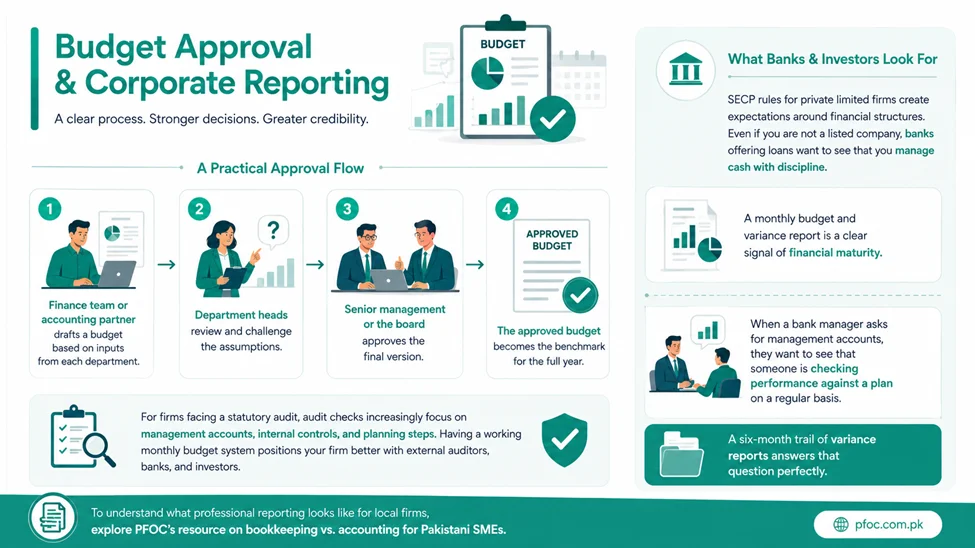
When a bank manager asks for management accounts, they want to see that someone is checking performance against a plan on a regular basis. A six-month trial of variance reports answers that question perfectly.
To understand what professional reporting looks like for local firms, PFOC’s resource on bookkeeping vs. accounting for Pakistani SMEs is worth reading.
How PFOC Helps Pakistani Businesses Build Better Systems
Building and keeping a budget system takes real effort. Many firms try and quietly give up after two months because the process feels too heavy.
PFOC works specifically with local firms to make this system last. They are not a generic accounting firm using templates made for foreign markets. They understand local tax structures, FBR timelines, the rupee’s shifts, and the specific hurdles local SMEs face daily.
Budget Templates Built for Your Model
PFOC builds custom monthly budget templates suited to your business model. Whether you are a trading firm, service provider, factory, or retailer, the format is designed for your team to use without needing a finance degree.
A Monthly Close Process That Happens
They set up a monthly close process so actual numbers get entered, reviewed, and acted on every single month. Not quarterly. Not at year-end. Monthly.
Clear Variance Analysis
PFOC prepares variance reports with clear notes, not just rows of numbers. You get a clear picture of what went right, what went wrong, and what it means for the month ahead.
Rolling Forecasts
They use rolling forecasts to update your financial plans based on current trends rather than guesses made a year ago. This is far more useful than staring at a stale budget.
Tax and Compliance Integration
PFOC integrates your FBR duties, advance tax schedules, and withholding tax deposits directly into the budget. No more surprise payments disrupting your cash. Their team’s expertise in withholding tax on salaries and vendor payments ensures these lines are accurate from the start.
Professional Financial Reports
For firms reporting to investors, boards, or bank teams, PFOC prepares management accounts in the exact format those stakeholders expect.
If your business is serious about financial discipline and you want a team that truly knows the local market, PFOC is worth a conversation. Visit pfoc.com.pk to learn more or get in touch directly.
Conclusion
A perfect budget that no one reviews is worth nothing. A simple budget reviewed every month is worth everything.
You do not need to solve everything at once. Start with a clean monthly format. Add the cash flow section. Run your first variance comparison after month one. Write the notes. Bring it to your next meeting and make it a routine. Then do it again next month.
The firms across Pakistan that survive inflation cycles and currency drops are not just lucky. They are the ones watching their numbers. They know where they stand by the 10th of every month. They make choices based on data instead of instinct alone.
That is the real value of a budget system that actually gets used. Not the spreadsheet. The discipline it creates.
Build it, use it, and adjust it as your business grows. Your cash flow, your team, and your peace of mind will all be better for it.