
Corporate Tax Rate in Pakistan 2026: Rates, Liability and Filing Penalties
Request a Free Quote

The standard corporate tax rate in Pakistan for Tax Year 2026 is 29%. A small company that meets the legal test pays 20% instead.
But not every small business meets that test. Your headline rate is rarely your final bill. Minimum tax, super tax, advance tax and withholding credits can all change the number you actually pay.
Companies with a 30 June year end must file by 31 December 2026. Tax Year 2026 also comes with a few new filing habits worth knowing about.
What Tax Year 2026 Actually Covers
Tax Year 2026 covers income earned between 1 July 2025 and 30 June 2026. This is the return most companies are working on right now.
Finance Act 2026 also brought real changes, including a lighter super tax and relief for exporters. But most of those changes apply from 1 July 2026 onward, which is Tax Year 2027, not the year you are filing for now.
Keep these two timelines separate as you read on. Mixing them up is one of the easiest ways to misfile.
The Standard Corporate Income Tax Rate
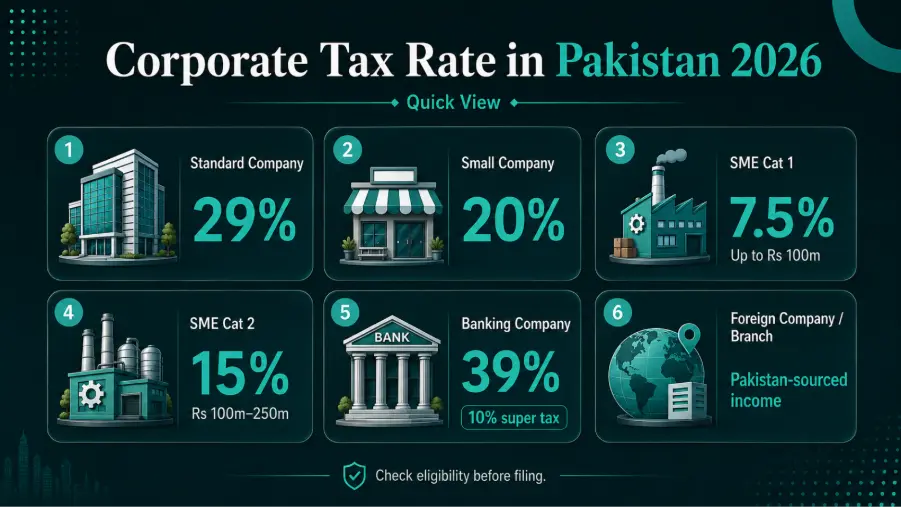
Most companies pay a flat 29% on their taxable income. This applies to both private and public limited companies. It is the default rate unless a special regime applies to your business.
The Small Company Tax Rate
A 20% small company rate does exist, but it comes with strict rules attached. Being small in a general sense is not enough on its own. Turnover, paid-up capital and the type of business you run all matter here. Your status is checked again every single year, so do not assume last year’s classification still holds.
Confirm this with your tax adviser before you rely on it, an area our financial consultancy services can help you review each year.
Rates for Banks, Foreign Companies and Special Cases
Banking companies pay a 39% corporate rate. On top of that, banks face a flat 10% super tax, no matter how large or small their income is within the higher brackets.
Foreign companies pay the standard rate, but only on income earned from Pakistan. This usually flows through a local branch, and any tax treaty in place may adjust the final figure.
Builders and developers follow their own regime entirely. Construction and sale of residential or commercial buildings is taxed at 10% of taxable profit, worked out as a share of gross receipts.
IT and IT-enabled services exporters registered with the Pakistan Software Export Board also get a special deal. Their export proceeds are taxed at a final rate of just 0.25%, a concession that Finance Act 2026 has extended through Tax Year 2029.
Which Rate Applies to Your Company
An ordinary private limited company pays 29%. The lower 20% rate only applies if you can prove small company status when you file.
People often mix up “small company” and “SME.” The rules for each are quite different.
A small company is judged under a specific Income Tax Ordinance test that looks at turnover, paid-up capital and business activity. That status is taxed at 20%.
An SME, by contrast, is a manufacturing firm under Section 2(59A) with turnover up to Rs 250 million. It is taxed at either 7.5% or 15%, depending on which turnover band it falls into.
A manufacturing SME is left out of the small company definition entirely. The two statuses never overlap, so check which box your business genuinely fits.
A resident company is taxed on its worldwide income, covering any firm built or run from Pakistan. A non-resident company is taxed only on the income it earns from Pakistan, usually through a branch office here.
How Corporate Tax Liability Is Worked Out
Start with your revenue. Subtract allowable expenses and any tax adjustments to arrive at your taxable income.
Apply the normal rate to that figure. Then compare the result against minimum tax on turnover, and pay whichever amount is higher.
Add super tax if your income crosses the threshold. Subtract advance tax you have already paid, along with any withholding credits you are entitled to.
What is left over is your final bill, or in some cases, your refund.
Why Audited Profit and Taxable Income Rarely Match
Your audited profit and your taxable income are almost never the same number. Tax law blocks certain expenses outright. It also adds back some accounting entries and applies its own depreciation rates instead of your usual accounting policy.
Costs spent wholly for business purposes are usually deductible. This covers salaries, rent, utilities, marketing, and financing costs within set limits.
Personal expenses routed through the company are often disallowed, and so are costs with no paper trail behind them. Keep receipts and contracts for anything significant.
Capital assets are not deducted all at once either. You cannot claim the full cost of a machine or vehicle in the year you buy it. Instead, tax depreciation is claimed gradually, over several years, at fixed rates set by law.
Is Corporate Tax Based on Profit or Turnover
Corporate tax is normally based on taxable profit. But a turnover-based minimum tax can take over in low-profit years.
Section 113 minimum tax asks for roughly 1.25% of gross turnover. This applies whenever the normal tax works out lower, and it applies even in a loss-making year.
When minimum tax is the higher figure, that is what you pay. The difference can often be carried forward against future profits, subject to time limits set in the Ordinance.
Can a Loss-Making Company Still Owe Tax
Yes, quite often. An accounting loss does not automatically mean zero tax due.
Minimum tax on turnover applies no matter what your profit looks like, and your filing duty continues regardless. This holds even in years when nothing is owed under the normal calculation.
Once a return is filed, taxable losses can usually be carried forward to offset future profits, subject to the conditions set out in the Ordinance. Confirm the current carry-forward period with your adviser rather than assuming it runs forever.
Super Tax on Companies in 2026
Super tax is an extra charge under Section 4C, sitting on top of your normal corporate tax. It kicks in once taxable income passes Rs 150 million.
For Tax Year 2026, rates rise in steps up to a top rate of 10% for income above Rs 500 million. Banks are taxed at a flat 10% regardless of how far above the threshold they sit, and oil, gas and fertiliser companies also tend to hit higher bands sooner.
Super tax is calculated separately from your normal tax, then added on top. It is not baked into the 29% headline rate.
What Changes from Tax Year 2027
Finance Act 2026 reshapes super tax quite significantly, but only from 1 July 2026 onward, which is Tax Year 2027. For most sectors, the middle bands between Rs 150 million and Rs 500 million are being removed, and the top rate is coming down from 10% to 8%.
Banks, oil and gas exploration companies, and fertiliser manufacturers are excluded from this relief and stay on the older, higher structure.
Exporters get a genuine win too. From Tax Year 2027, a company whose export proceeds make up more than 80% of its total turnover will not owe Section 4C super tax at all. If your business leans heavily on exports, this is worth planning around now, even though it does not change your Tax Year 2026 bill, and it’s a good opportunity to review your position through our investment consulting services.
What Is Your Effective Corporate Tax Rate
The legal 29% rate is rarely what a company actually pays. Minimum tax, super tax, blocked expenses and available credits all shift the real number up or down.
Two companies with similar revenue can end up with very different final bills, depending on their turnover mix, sector, and how much of their income is export-based.
The most reliable way to know your own effective rate is to run the full calculation. Work out your normal tax, compare it to minimum tax on turnover, add any super tax owed, then subtract your advance tax and withholding credits. That final figure, divided by your taxable income, is your true effective rate.
Advance Tax and Withholding Tax
Advance tax under Section 147 asks companies to prepay estimated tax each quarter, instead of settling one large bill at filing time.
The estimate usually builds on last year’s tax position, adjusted for current turnover. If your results shift a lot during the year, a fresh estimate may be needed.
This approach avoids a nasty underpayment surprise later. Advance tax you have already paid gets credited against your final bill, lowering what you owe when you file.
Withholding tax works differently. It is deducted at source by customers, banks or other payers, who then deposit it with FBR on your behalf.
It is not a separate tax in its own right. For most transactions, it is simply adjustable against your final corporate tax bill.
Match every withholding certificate you receive during the year against your records. Missing credits are one of the most common, and most costly, filing mistakes companies make.
Corporate Income Tax Return Requirements
Every registered company must file a corporate income tax return. This covers trading firms, loss-making firms, low-activity firms and most dormant companies still on the register.
You will typically need audited financial statements, a full tax computation, and clear income and expense records. Advance tax records, withholding certificates, bank statements and company details round out the list, all of which is far easier to keep current with proper accounting support running through the year rather than assembled at the last minute.
Your filed return and your audited accounts need to line up. Any gap between the two is a quick way to draw an FBR query.
Filing Through FBR IRIS in 2026
All corporate returns now go through the FBR IRIS portal, which was refreshed as IRIS 2.0 in 2026 with a cleaner interface and a single dashboard for returns, registration and payments. There is no paper option left for companies.
Finance Act 2026 also introduces a “faceless” system for audits, assessments and appeals, run through a new National Faceless Center. Under this system, the identity of the reviewing tax officer stays confidential, which is meant to reduce bias and speed up routine cases. This rolls out from Tax Year 2027 alongside the other Finance Act 2026 changes, and staying ahead of it is exactly the kind of ongoing work covered by our statutory compliance services.
For your Tax Year 2026 return, the practical steps stay familiar. Finalise and audit your accounts first, then work out taxable income, adjusting for blocked expenses and tax depreciation.
Match your advance and withholding tax against your ledger. Complete the IRIS return and its schedules, pay any tax still owed, then keep your acknowledgement as proof of filing.
Filing and Payment Deadlines
Companies with a 30 June year end generally file by 31 December 2026, later than the 30 September deadline that applies to individuals and AOPs.
Companies with a special tax year follow their own accounting year end instead, so do not assume the standard deadline applies to your business too.
FBR has granted short extensions in past years through official notices, but these are never guaranteed. Plan to file by the standard date and treat any extension as a bonus, not a backup plan.
Unpaid tax is normally payable at the time of filing, alongside any advance tax instalments already due. Unpaid tax also draws a default surcharge under Section 205, which is separate from any penalty for filing the return itself late.
Late Filing Penalties in Pakistan
A late corporate tax return triggers a penalty under Section 182. Reporting from recent filings suggests a minimum penalty of roughly PKR 40,000 applies automatically once a return is late, on top of a daily charge tied to tax payable. Confirm the exact current figure against the latest FBR notice before you rely on it, since these amounts are reviewed from time to time, and where a dispute or notice follows, our legal consultancy services can help you respond correctly.
An ATL surcharge is a separate, stand-alone charge. It applies when a company wants to be restored to the Active Taxpayer List after missing the deadline, and it is not the same thing as the Section 182 penalty. Both charges can apply together.
| Consequence | Trigger | What It Means | What To Do |
|---|---|---|---|
| Section 182 penalty | Return filed after deadline | Daily charge on tax payable, with a minimum amount | File as soon as possible |
| ATL surcharge | Restoring filer status | Separate payment to re-enter the Active Taxpayer List | Pay promptly to get lower withholding rates back |
| Default surcharge (Section 205) | Tax unpaid past due date | Charge that grows on the outstanding balance | Settle tax alongside filing |
| FBR notice | Non-filing or data mismatch | A formal request for an explanation | Reply within the stated deadline |
If You Have Already Missed the Deadline
First, check exactly which return is still outstanding, and finish any missing financial data. Work out the correct liability, including penalties, then file the outstanding return through IRIS.
Pay the tax and charges due and check your Active Taxpayer List status afterwards. Review your account for any FBR notices and bring in expert help if the numbers still feel unclear.
Revisions, Dormant Companies and FBR Notices
Companies revise returns for a few common reasons: missing income, wrong expense claims, calculation errors, or unclaimed withholding credits. A revised return usually needs Commissioner approval, unless you revise it within a short window right after the first filing. Confirm the current time limit before you submit one.
A dormant company with no sales or activity often still has a filing duty, as long as it stays registered. This also applies to new companies that have not started trading yet, so do not assume a quiet year removes the requirement, and getting your SECP company registration details right from the outset makes this ongoing duty much easier to track.
If a notice arrives, start by identifying the tax year and legal section involved, and note the exact reply deadline. Compare the notice against your filed return and gather your supporting documents.
Reply through the correct FBR process, on time. If a large amount or a tricky transaction is involved, bring in expert help early rather than waiting.
Never ignore a notice. Silence usually leads to a worse outcome than even a basic, timely reply.
Keep good records all year round. Sales and purchase invoices, bank statements, payroll records, withholding certificates and your yearly tax workings all matter. FBR increasingly cross-checks your return against your financial statements and outside data, so gaps between the two raise your audit risk.
Corporate Tax Planning in Pakistan
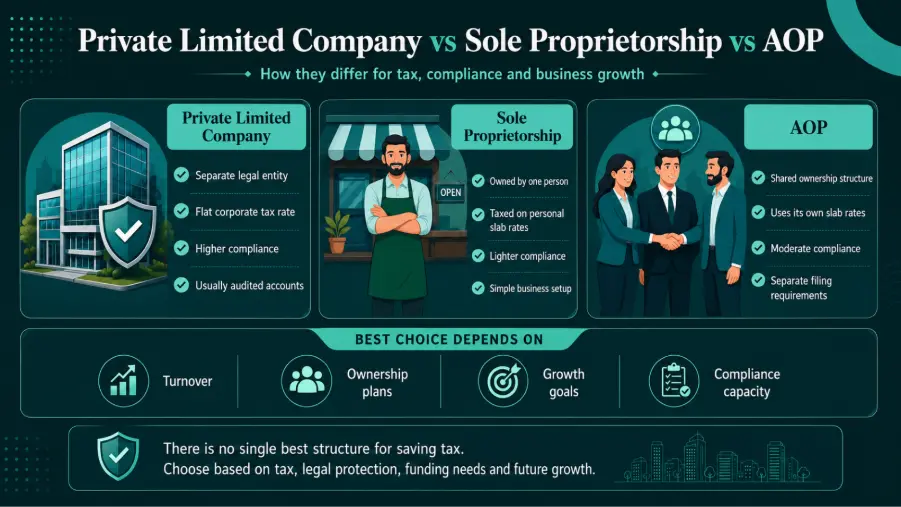
Tax planning works best as an ongoing habit, not a once-a-year scramble. Confirm your classification every year and review your allowable deductions before you close the accounts, a process our tax planning services are built around.
Plan capital spending with depreciation timing in mind. Match your advance and withholding tax every quarter and work out your minimum tax and super tax exposure well before year-end.
Legal tax planning means using the rules as written to manage your bill sensibly. This is entirely different from tax evasion, which means hiding income or claiming costs you cannot back up with real documents.
Common Corporate Tax Mistakes to Avoid
Some mistakes cost businesses the most, yet they are easy to avoid once you know about them. Assuming every company pays the same rate is one of the biggest mistakes.
Mixing up small companies with SMEs is another common slip, and so is treating accounting profit as taxable income without making any adjustments.
Ignoring minimum tax or super tax exposure causes real trouble too, and missing withholding credits is a frequent, avoidable loss.
Thinking a loss year removes your filing duty is another trap, as is confusing the ATL surcharge with the Section 182 late filing penalty. Ignoring an FBR notice altogether tends to be the costliest mistake of them all.
What Should Your Company Do Next?
Start by confirming which corporate tax regime applies to your company. Check whether you qualify for the small-company rate, whether minimum tax could apply despite low profits, and whether super tax affects your position.
Before filing, reconcile your accounts, advance tax, and withholding credits. If you have already missed the deadline or received an FBR notice, act quickly rather than letting the issue grow.
If your tax position is unclear, PFOC can help. Our corporate tax professionals can review your liability, filing requirements, tax credits, penalties, and planning opportunities, then guide you on the right next step for your business.
Need help with corporate tax in Pakistan? Contact PFOC for practical support with tax calculations, return filing, compliance, FBR notices, and corporate tax planning.
FAQS
The standard rate is 29%. A lower 20% rate applies to companies that meet the small company rules.
Firms that meet the legal small company test based on turnover, paid-up capital and business activity. Feeling small in scale is not enough on its own.
Normal tax is based on taxable profit. But Section 113 minimum tax can apply on turnover when the profit-based figure works out lower.
Companies with a 30 June year end generally file by 31 December 2026, for Tax Year 2026.
A daily penalty applies under Section 182, with a minimum charge of roughly PKR 40,000 based on recent reporting. Confirm the exact current figure against the latest FBR notice.