
Withholding Tax on Salary in Pakistan Explained: Complete Guide (2026)
Request a Free Quote

Taxes in Pakistan can be hard to follow. Many workers see deductions but do not know why. Employers also struggle to meet the Federal Board of Revenue rules. Knowing how salary tax works saves you money. It also keeps your business safe from fines.
This guide covers the rules, rates, and steps for 2026. It helps both workers and employers handle payroll with ease.
What Is Withholding Tax on Salary in Pakistan?
Withholding tax on salary means your employer cuts tax before paying you. They call this a tax deduction at source. Tax is split across 12 monthly payments. You never owe a large sum at year-end. The Federal Board of Revenue gets this tax through employers. Employers work out, cut, and pay the right amount each month.
This monthly cut is not always the final amount. It works under an adjustable tax system. When you file your return, the cut amount is checked against your full income.
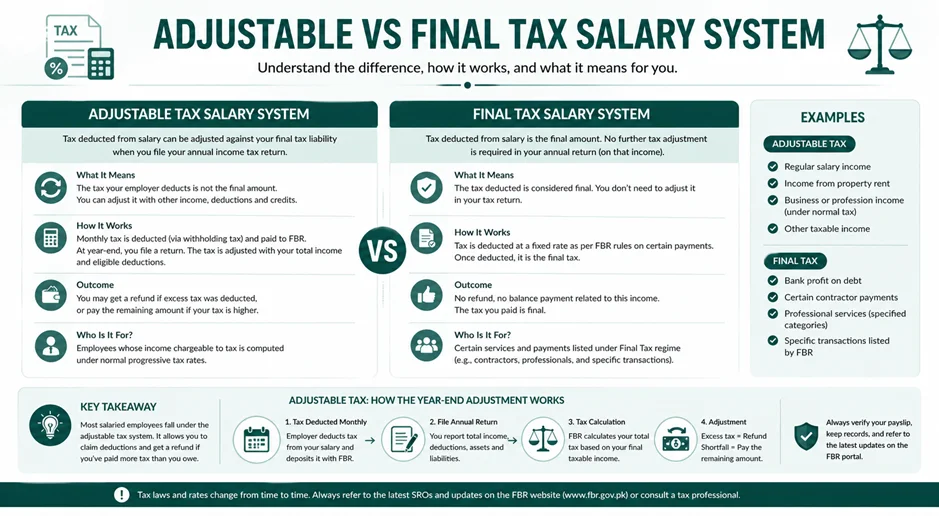
How Salary Tax Works in Pakistan
Your gross salary is the full amount your employer pays you. Your taxable salary is what is left after removing exempt items.
Employers estimate your full-year income at the start of each tax year (July to June). They work out the total tax on that figure. Then they split it by 12 to get your monthly cut. Your monthly cut can change during the year. A pay rise, a bonus, or a new budget can all affect it.
Salary Tax Slabs in Pakistan for 2026
Pakistan uses a step-based tax system. Higher income means a higher tax rate. The lowest taxable salary is PKR 600,000 per year. That is PKR 50,000 per month. Income below this is not taxed.
Each step above this limit has its own rate. Steps can change with each federal budget. Always check the latest rates with the Federal Board of Revenue.
How to Calculate Salary Tax (Step-by-Step)
Understanding how to calculate salary tax helps you verify deductions. It also ensures accurate payroll management handling.
Step 1: Calculate Annual Income
Multiply your monthly salary by 12.
Step 2: Add Additional Earnings
Include bonuses, incentives, and taxable benefits.
Step 3: Identify Your Tax Slab
Match your total income with the correct bracket.
Step 4: Apply the Tax Rate
Calculate tax on the amount above the slab limit.
Step 5: Find Monthly Deduction
Divide the total tax by 12. This gives your monthly salary tax deduction.
Why Your Salary Tax Changes Every Month
Your take-home pay can shift from month to month. Here are the main reasons:
- Pay Rises: A mid-year raise pushes your annual income higher. This moves you into a higher tax step right away.
- Bonuses: Bonuses are added to your annual income total. This often causes a one-time spike in that month’s tax.
- Employer Fixes: If too little was cut earlier, your employer makes up for it in later months.
- Year-End Review: Every June, employers check the full year and fix any gap to match FBR rules.
Common Salary Tax Problems and Solutions
Many employees face issues with withholding tax for salary. Here are common scenarios:
- Problem: Incorrect tax deduction.
- Cause: Errors in payroll software or wrong slab application.
- Solution: Request a tax computation sheet from your HR department and compare it with FBR rates.
- Problem: Over-deduction.
- Cause: Failure to account for tax credits or investment deductions.
- Solution: Provide proof of investments or paid bills to your employer for adjustment.
- Problem: Multiple income confusion.
- Cause: Having two jobs or a side business.
- Solution: Combine both incomes when filing your FBR salary tax return to avoid penalties.
What to Do If Tax Is Deducted Incorrectly
If you notice a mistake, take action immediately. First, verify your deductions by checking your monthly payslip against a salary tax calculator.
If the employer deducted too much, you could often correct this through your annual tax return. You can claim a salary tax refund process by showing that your total tax paid exceeds your actual liability. For immediate fixes, speak with your finance department to adjust the following month’s deduction.
Employer Withholding Tax Rules in Pakistan
The employer withholding tax rules are strict. Companies must:
- Deduct tax from every employee earning above the threshold.
- Deposit the tax into the government bank (National Bank of Pakistan) within the specified timeframe.
- File an employer monthly tax return through the IRIS portal.
- Provide a salary tax certificate format (Form 16) to employees at the end of the year.
Employer Penalties and Compliance Risks
Ignoring tax rules can create serious problems for employers. The employer tax penalty in Pakistan rules are strict and enforced regularly.
Late deposits lead to extra charges. Interest or surcharges apply on unpaid amounts. If tax is not deducted at all, the employer still pays it. This often comes from the company’s own funds. Repeated errors increase risk. Authorities may start a detailed audit of the business.
To stay protected, businesses should consider working with a statutory compliance specialist to manage their obligations proactively.
Withholding Tax Filing Process
The withholding tax filing process is handled online. Employers use the IRIS portal each month. They report total salaries paid and tax collected. This record must match actual deductions. The deadline is fixed. Most filings must be completed by the 15th of the next month. Missing it can lead to penalties.
How to File Salary Tax Return (Step-by-Step)
Even when tax is deducted, filing is still required. Every employee must complete a return.
Step 1: Log in to IRIS
Use your CNIC and password to access your account.
Step 2: Prepare Your Documents
Keep your salary certificate and financial details ready.
Step 3: Enter Salary Details
Add total income and tax deduction at source salary.
Step 4: Declare Assets
List bank balances, property, and vehicles clearly.
Step 5: Submit the Return
Review all entries before submission. Small errors can cause delays.
Salary Tax Exemptions and Legal Ways to Reduce Tax
You can reduce tax legally with proper planning. A salary tax exemption approach helps manage your liability. Working with a tax planning expert can help you identify every legal avenue available.
Tax credits are one option. Investments in approved pension funds or shares may reduce tax. Donations also help. Contributions to approved charities can lower taxable income. Some professionals receive relief. Full-time teachers and researchers may qualify for a partial tax reduction.
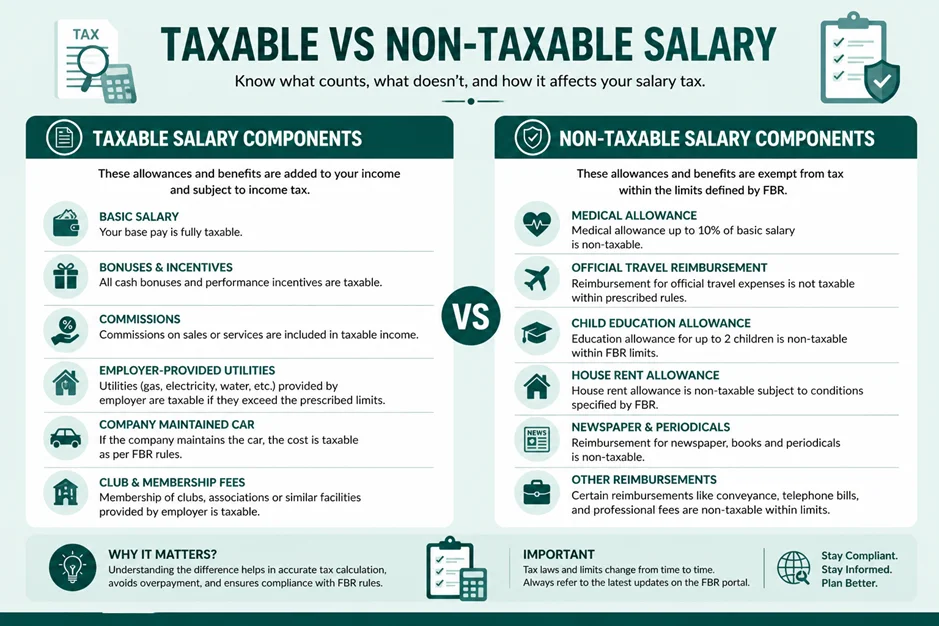
Taxable vs Non-Taxable Salary Parts
Not every part of your salary is taxed the same way.
Taxable items include:
- Basic pay
- Bonuses and sales commissions
- Some perks like utility payment
Partly exempt items include:
- Medical pay within set limits
- Work travel refunds
Knowing this helps you manage your salary tax in Pakistan more effectively.
Salary Tax Compliance Checklist
For Employees:
- Collect your pay slip every month.
- Ask for your annual tax form in July.
- Check your status on the FBR Active Taxpayers List.
- File your annual return before September 30th.
For Employers:
- Check all staff CNICs before running payroll.
- Apply the right tax rate for each income level.
- Pay tax within 7 days of paying salaries.
- Submit monthly tax reports on time through IRIS.
Conclusion
Withholding tax on salary affects every worker in Pakistan. Workers who understand it avoid overpaying. Employers who follow the rules avoid fines and audits.
Tax laws change each year. Keeping up takes time and skill.
At PFOC, we make this simple. Our team handles payroll management and individual tax filing with care. Get your tax right today and protect your future. Book a free consultation with our experts no
FAQS:
It is a tax cut from your salary before you get paid. Your employer handles the cut and sends it to the FBR. You adjust the final amount when you file your annual return.
The employer cuts it. They work out your tax based on your annual income and cut a portion each month. Workers should still check that the right amount is being cut.
Generally yes. The 15th is standard across PESSI, SESSI, KPK-ESSI, and B-ESSI.
Pakistan uses income brackets. Each bracket has a set rate. Higher income falls into higher brackets. Rates may change with each annual budget.
Employers guess your annual income and work out the full-year tax. They split that by 12. The result is your monthly deduction.
Some pay items and perks lower your taxable income. The exact amounts depend on current FBR rules and your work terms.
Income below PKR 600,000 per year is not taxed. That is PKR 50,000 per month. This limit may change with each budget.
Employers must pay tax within 7 days of paying salaries. Late payments attract fines.
What is the due date for the withholding statement (Form 165)?
Employers must file their monthly report by the 15th of the next month.
Late payments attract interest charges. Ongoing delays raise the risk of a formal FBR audit.
Not filing can lead to fines and FBR notices. It may also trigger a wider review of the business.
Log in to the IRIS portal with your CNIC. Your tax record will show if your employer paid the right amount.
Ask your HR or finance team. Employers must issue this form at the end of each tax year.
Yes. If you paid more than needed, you can claim a refund when filing your annual return.
Employers cut taxes for workers automatically. Contractors manage their own tax duties. Their rates and rules may differ.
Employers must keep full payroll records. This includes pay details, monthly cuts, and payment proof. These records are key during FBR audits.