
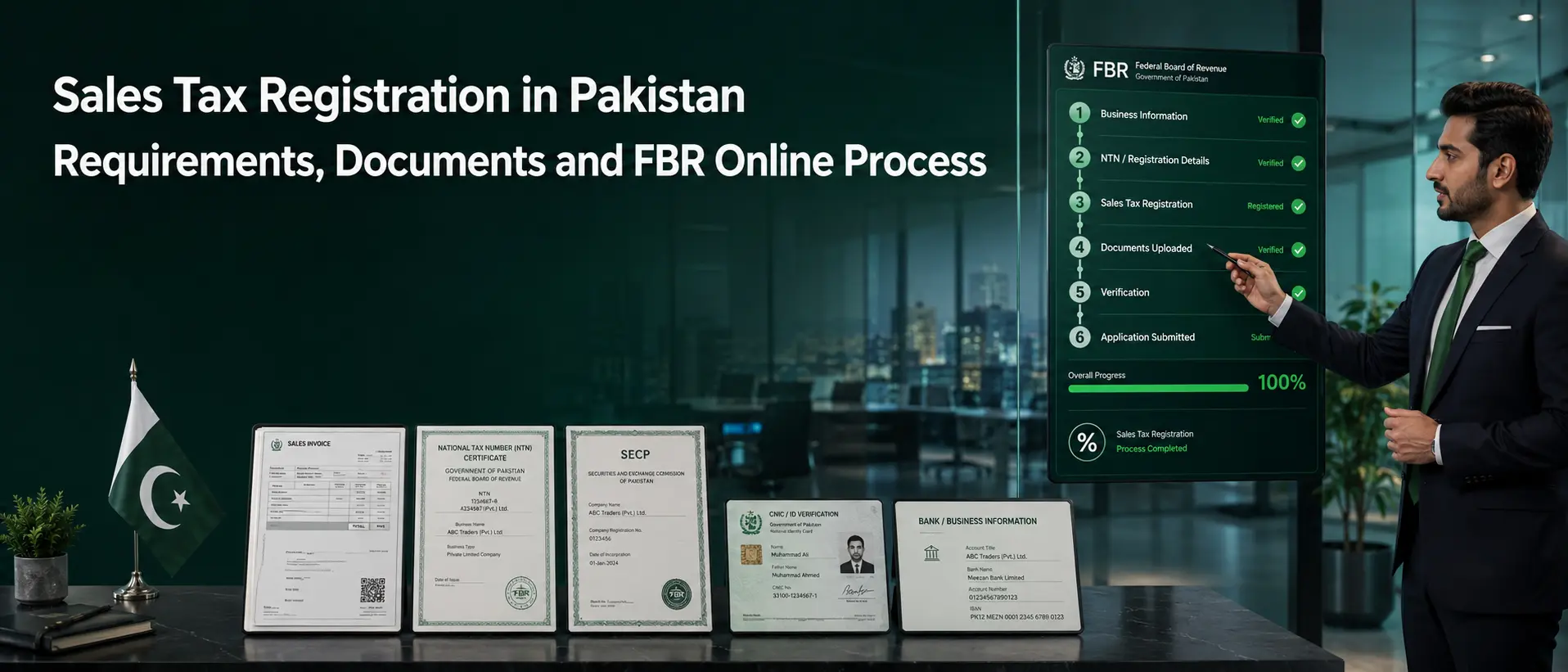
Many business owners get stuck on one question. Do I need sales tax registration, or can I skip it?
The confusion is fair. Rules change based on what you sell. They also change based on how much you earn, and where you work. A shopkeeper, a maker, and a service exporter can all get different answers.
This guide explains who must register. It also explains which office applies to you. You will learn what papers FBR asks for. You will learn how the online IRIS process works. And you will learn what to do once you hold an STRN.
What Is Sales Tax Registration in Pakistan?
Sales tax registration means signing up your business with the Federal Board of Revenue. Once you sign up, you can charge and collect sales tax on taxable supplies, which is why most owners fold this into their wider tax planning from the outset. FBR runs this through IRIS.
Once FBR says yes, you get a Sales Tax Registration Number. You also take on new jobs. These include filing monthly returns. They also include issuing proper invoices.
What Is a Sales Tax Registration Number (STRN)?
An STRN is the unique number FBR gives you once it approves your application. It shows your business can charge sales tax. It also lets you claim input tax.
You use this number on every invoice. You use it on every return too.
Get Expert Guidance for Your Business
Get Expert Guidance for Your Business
Who Is Required to Register for Sales Tax in Pakistan?
There is no single rule for every business. Section 14 of the Sales Tax Act, 1990 lists set groups. So, your case depends on what you do. It does not depend on your size.
Importers
Every commercial importer of taxable goods must register. This rule applies no matter how much you earn.
Manufacturers
A maker must register unless it counts as a cottage business. To count as one, you need:
- No industrial gas or power connection
- A home-based spot
- No more than ten workers
- Sales under Rs 10 million
Miss even one of these, and you must register.
Wholesalers, Dealers and Distributors
Wholesalers, dealers, and distributors of taxable goods must register. There is no sales test for this group.
Retailers and Tier-1 Retailers
Small shops below Tier-1 rules usually stay outside forced registration. But a shop becomes Tier-1 in a few common cases. Once that happens, you must register with POS setup, a process our FBR POS integration and e-invoicing services are built to handle.
You may fall into this group if you are part of a chain. You may also fall into it if you sell from a cooled mall or plaza. It also applies if your power bill has crossed Rs 1,200,000 in the last year. Being both a wholesaler and a retailer can trigger it too. So can taking card or digital payments. So can crossing the tax limit under sections 236G or 236H.
FBR updates these rules from time to time. So always check the current numbers. Do not assume you are exempt.
Exporters and Zero-Rated Suppliers
Exporters do not always feel the same push as local suppliers. But registration starts to matter once you want a refund on export-linked input tax.
Do Sole Proprietors and Small Businesses Need Sales Tax Registration?
It depends on what you do, not your size. You must register if you are a lone owner making goods above cottage limits. You must also register if you import goods or run a Tier-1 shop. A home-based cottage seller usually does not need to.
Do Freelancers and Service Businesses Need FBR Sales Tax Registration?
Usually, no. Sales tax on services mostly falls under provincial law instead. So, check if your specific service is taxed in your province first. Do this before you assume FBR rules apply to you.
What Is the Sales Tax Registration Limit in Pakistan?
There is no single limit that covers every group. Importers, wholesalers, and non-cottage makers must register no matter their sales.
Makers only get a break under cottage rules. One of these is the Rs 10 million cap. Retailers are judged mainly on Tier-1 rules, not one flat number.
This layered setup is why generic advice online often misleads readers. Always check your own group first.
Can You Register for Sales Tax Voluntarily?
Yes. A business that does not have to register can still apply. Owners often do this to claim input tax. It can also help you look more trustworthy to big buyers.
Keep in mind that this still brings full duty to follow the rules.
FBR Sales Tax vs Provincial Sales Tax Registration
Mixing up federal and provincial sales tax is one of the costliest slips owners make. Getting this right early can save you a lot of trouble later.
When Does FBR Sales Tax Registration Apply?
FBR rules cover businesses that supply goods. This means makers, importers, wholesalers, distributors, and Tier-1 shops.
When Does Provincial Sales Tax Registration Apply?
Provincial offices handle sales tax on services within their area. This could mean the Punjab Revenue Authority, the Sindh Revenue Board, the Khyber Pakhtunkhwa Revenue Authority, or the Balochistan Revenue Authority.
Can a Business Need Both Federal and Provincial Sales Tax Registration?
Yes. This happens more often than owners expect. Say your business sells goods but also bills for setup or advice work. In that case, you may need FBR rules for the goods. You may also need provincial rules for the service.
Which Sales Tax Registration May Apply?
| Business Activity | Likely Authority |
|---|---|
| Selling made or imported goods | FBR (federal) |
| Wholesale or spread of goods | FBR (federal) |
| Giving a taxed service in a province | Matching provincial office |
| Selling goods and billing services together | Maybe both |
Sales Tax Registration Requirements in Pakistan
Before you apply, check the core needs. You will need a live FBR IRIS profile with active income tax status. You also need a clear note on what your business does.
You need a set business address too. You need a bank account in the business or owner’s name. Add branch info if it applies to you. You also need power or gas links that match your address, plus true owner info.
Together, this forms the core FBR checklist. That said, the exact proof still shifts by business type.
Requirements for Sole Proprietors and Individuals
You need a valid CNIC, an active NTN, a personal bank note, and proof of your shop or office.
Requirements for Partnerships and AOPs
You need a partnership deed. You need the CNIC of each partner. You need a bank account in the group’s name.
Requirements for Companies
You need SECP setup papers, a step covered in our guide to SECP company registration online in Pakistan. You need CNICs for the director and top officer. You need a company bank note.
Additional Requirements for Manufacturers
Makers also need power links, machine details, and proof of the plant. FBR checks this group more closely.
Documents Required for Sales Tax Registration in Pakistan
The papers you need shift by business type. Still, this list covers what most people need to send in.
| Category | Typical Documents |
|---|---|
| Identity | CNIC of owner, partners or directors |
| Business registration | NTN certificate, SECP or partnership documents |
| Bank details | Bank note in the business name |
| Premises | Ownership or rental proof, address |
| Utilities | Power or gas account number |
| Photos | GPS-tagged photos of the site |
Identity and Business Registration Documents
Solo owners need a CNIC and an NTN. Firms need SECP papers plus director CNICs, and getting your company name reserved with SECP correctly at the outset avoids mismatches later. Partners need their deed and every partner’s CNIC.
Together, these form the base papers for sales tax. This holds no matter what your business does.
Bank Account Details and Supporting Evidence
FBR asks for a bank note. It must show a name that matches your set name exactly. A wrong name is one of the top reasons apps get turned down.
Business Premises and Address Documents
You need ownership or lease proof for your shop or office. Make sure the address matches the rest of your IRIS profile.
Electricity, Gas and Utility Information
FBR asks for your account or link number. The address on your bill should match your set business address too.
GPS-Tagged Photographs of Business Premises
FBR wants GPS-tagged photos of your site. Makers also need photos of their machines and meters.
These photos prove your business is real. They show it truly sits at that spot.
Additional Documents and Evidence for Manufacturers
Makers should keep machine details ready. They also need power link proof and clear site photos. These sit next to the wider papers this group needs.
How to Apply for FBR Sales Tax Registration Online
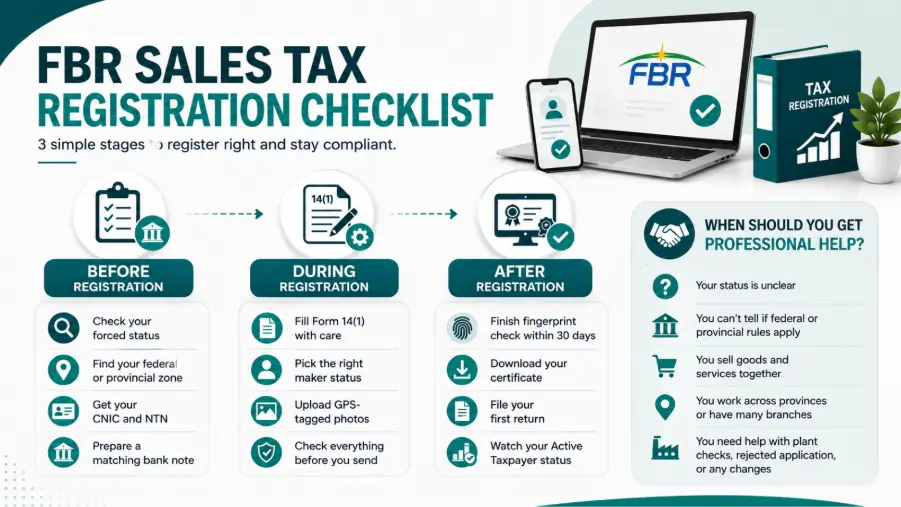
FBR Sales Tax Registration Process:
- Get your IRIS profile and papers ready
- Log in to the FBR IRIS site
- Open Form 14(1) for sales tax
- Pick maker or non-maker status
- Enter business and set-up details
- Add bank account info
- Add branch and site details
- Enter power and gas info
- Upload GPS-tagged photos
- Check and send
This is the core of the process. Here is what each step means.
Step 1: Prepare Your FBR IRIS Profile and Documents
First, check your income tax status is live. Then get your CNIC, bank note, address proof, and power details ready.
This gets you set to apply.
Step 2: Log In to the FBR IRIS Portal
Use your IRIS login to start your sales tax sign-up online. If you have never signed up for income tax before, do that first.
Step 3: Open Sales Tax Registration Form 14(1)
Go to the Registration menu. Pick Form 14(1). This is the form for the simple sign-up route.
Step 4: Select Manufacturer or Non-Manufacturer Status
This one pick changes which papers and checks apply to you. So choose with care.
Step 5: Enter Business and Registration Details
Give your business name, work type, start date, and role. Make sure it all matches your NTN profile exactly.
Step 6: Enter Bank Account Information
Add your bank note details here. The name must match your set business name.
Step 7: Add Business Branches and Locations
If you work from more than one spot, list every branch. Each one may need its own check.
Step 8: Enter Utility Connection Details
Give your power and gas account numbers. Make sure the meter details match your set address.
Step 9: Upload Required GPS-Tagged Photographs
Upload clear GPS-tagged photos of your site. Add machine photos too if you make goods.
Step 10: Review and Submit Form 14(1)
Before you hit send, check everything twice. Make sure your address, bank details, and power info all line up. Small slips are still the top cause of delay.
What Happens After You Submit the Sales Tax Registration Application?
Sending the form is not the last step. FBR still needs to check your details before your status turns live.
FBR Application and Business Verification
FBR may check your ID papers, your stated work, and your address. It can also check your power links, bank details, and site before it closes out your sign-up.
Is Biometric Verification Required for Sales Tax Registration?
Yes, it is. After you sign up through IRIS, you must visit a NADRA e-Sahulat spot within 30 days. There, you finish a fingerprint check.
If you skip this step, or the check fails, FBR drops you from the Sales Tax Active Taxpayer List.
Does FBR Physically Verify Manufacturing Premises?
For makers, FBR may run extra checks. These can happen through field offices or an approved third party. If a paper turns out weak later, you usually get a short window to fix it. This is often around fifteen days.
How Long Does Sales Tax Registration Take in Pakistan?
There is no fixed time here. Speed depends on how full your papers are. It also depends on how well your form lines up, and if your business type needs extra checks.
How to Download a Sales Tax Registration Certificate
What Is a Sales Tax Registration Certificate?
Your sales tax certificate is the proof paper that shows your STRN and your live status. You use it to show your standing to buyers, sellers, and tax offices.
How to Download Your Sales Tax Registration Certificate From FBR
Log in to IRIS. Go to the Registration part. Pick the option to view or print your Form 14(1) certificate once your status shows active.
That is how you get a copy any time you need one.
How to Check Your Sales Tax Registration and Active Status
You can check your STRN and current status through the FBR online check tool. Just enter your number or CNIC.
STRN vs Active Taxpayer Status: What Is the Difference?
Holding an STRN means you are signed up. Being on the Active Taxpayer List means more. It means you also follow the rules. You have done the fingerprint check and filed your returns on time.
A signed-up business can still fall off the active list if it skips these steps.
Common FBR Sales Tax Registration Problems and Solutions
Sales Tax Registration Application Cannot Be Submitted
This usually happens due to a gap in your IRIS profile, or a missed field. Check every part of Form 14(1) before you try again.
Business Address or Utility Information Does Not Match
Gaps between your IRIS profile, your bill, and your site papers are a top cause of rejection. Line up all three so they say the same thing.
Bank Account Information Is Not Accepted
This often happens when the name on the account does not match your set business name. Ask for a fixed bank note before you try again.
Wrong Manufacturer or Non-Manufacturer Status Was Selected
If this happened to you, send a fix request through IRIS or your Regional Tax Office. This matters, since your status decides which checks apply to you.
Biometric Verification Was Not Completed
Visit a NADRA e-Sahulat spot as soon as you can. Delays here hurt your Active Taxpayer status.
Sales Tax Registration Application Is Delayed or Rejected
Check the reason for rejection shown in IRIS closely. Most delays trace back to paper gaps. Fixing the flagged issue usually clears the hold, and where the issue touches on wider regulatory exposure, our legal consultancy support can help you work through it.
What Should You Do After Sales Tax Registration?
Getting your STRN is where your duties start, not where they end.
File Sales Tax Returns
Signed-up businesses must file a sales tax return every month. You need to state your supplies and tax status. Do this even in months with no sales at all.
Understand Input Tax and Output Tax
Output tax is what you charge your buyers. Input tax is what you pay on your own buys.
Say you charge Rs 18,000 in output tax. You paid Rs 10,000 in input tax. You would deposit the gap. That is Rs 8,000.
Issue Compliant Sales Tax Invoices
Every invoice you send must show your STRN and the right tax amount. Slips here can hurt your standing. They can also stop your buyer from claiming input tax.
Maintain Sales Tax Records
Keep clean records of your sales, buys, and imports. Also keep invoices, credit and debit notes, bank slips, stock records, and power bills. FBR can ask to see these during any check.
Maintain Active Sales Taxpayer Status
Staying on the Active Taxpayer List rests on two things. You need to finish the fingerprint check. You also need to file your returns on time. Falling off this list can matter to buyers, since many prefer active, checked sellers.
How to Change, Update or Cancel Sales Tax Registration
How to Update Sales Tax Registration Details
You can update changes to your address, work type, or other facts through your IRIS profile. Just use the fix option there.
When Is a Revised Sales Tax Registration Certificate Required?
You need a new one when core facts change. This means your business name, address, or work type. Your certificate should always show your current facts.
How Does Sales Tax Registration Transfer Work?
If your business moves between tax zones, your file must move too. It goes to the right Regional Tax Office. You do this through IRIS.
How to Deregister from Sales Tax
Closing your sign-up makes sense when a business shuts down. It also makes sense if you switch to work outside sales tax scope or no longer meet the forced rules. Usually, you need to clear open returns and debts first.
What Happens If a Business Does Not Register for Sales Tax?
FBR can sign up a business by force if it meets the forced rules. This holds even if the business never applied on its own. Running without the right sign-up puts you at risk of tax demands, late fees, and fines under the Sales Tax Act, 1990.
Charging sales tax without proper sign-up adds even more legal risk. The safe path is always to check your standing early. Do not wait for FBR to find the gap on its own.
Common Sales Tax Registration Mistakes to Avoid
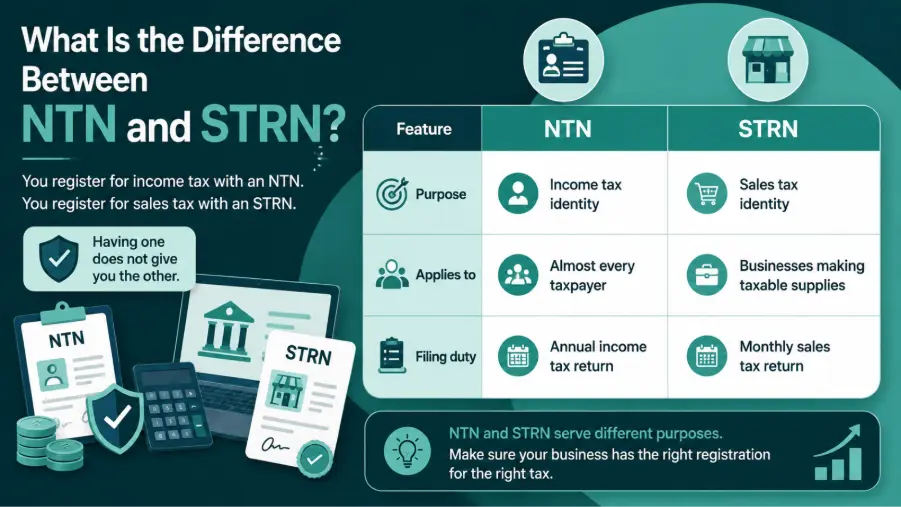
- Mixing up NTN with STRN
- Trusting an old sign-up limit
- Signing up with the wrong office, federal or provincial
- Picking the wrong maker status
- Letting your address differ across papers
- Sending bank details that do not match your name
- Uploading poor or non-tagged photos
- Missing the fingerprint check deadline
- Assuming an STRN ends all further duties
- Missing monthly filings or business updates
FAQS
Importers, non-cottage makers, wholesalers, distributors, and Tier-1 shops must usually register. Exporters who want refunds usually need to as well.
You typically need a CNIC or SECP papers, an NTN certificate, a bank note, address proof, power details, and GPS-tagged photos of your site.
There is no fixed time. It depends on how full your papers are, and if your business type needs extra checks.
Yes. You must finish it at a NADRA e-Sahulat spot within 30 days of signing up. Skip it, and you risk removal from the Active Taxpayer List.
You risk tax demands, late fees, and fines. There is also legal risk if you charge sales tax without a valid sign-up.
Conclusion: What Should You Do Next?
If you are still unsure where your business fits, work through this path step by step.
- Find out if you supply goods, services, or both.
- Work out if FBR or a provincial office applies to you.
- Check if you fall into a forced sign-up group.
- Check the latest rules or limit for your group.
- Get your papers ready ahead of time.
- Review your FBR IRIS profile for gaps before you apply.
- Fill Form 14(1) where FBR rules apply to you.
- Finish the fingerprint check and any other checks fast.
- Confirm your sign-up and Active Taxpayer status.
- Stay on top of filing and record-keeping duties.
At PFOC, we assess your registration position, prepare the required documents, manage your FBR sales tax registration, and support applicable POS integration and post-registration compliance. Contact PFOC if you need professional guidance before or after registration.