
Cash Flow Forecasting for Small Businesses in Pakistan – Template & Step-by-Step Guide
Request a Free Quote

A small business is a daily grind in Pakistan. You pay your bills, you sell, and you watch your cash. There’s also a need to understand the inflow and outflow of cash. A month of making money can turn into a month of “no money.” A month with profit can still leave you with no cash.
Customers pay late. Suppliers send bills. Salaries, rent, and taxes are paid on different dates. But for some months, you have cash. Some months you don’t. A cash flow forecast will reveal to you the risky months. Then you’ll have time to plan.
See how to create a cash flow forecast step-by-step. Easy methods and tools will also be taught, as well as templates. You can also get planning, forecasting, reports, and financial advice from PFOC.
What Is a Cash Flow Forecast?
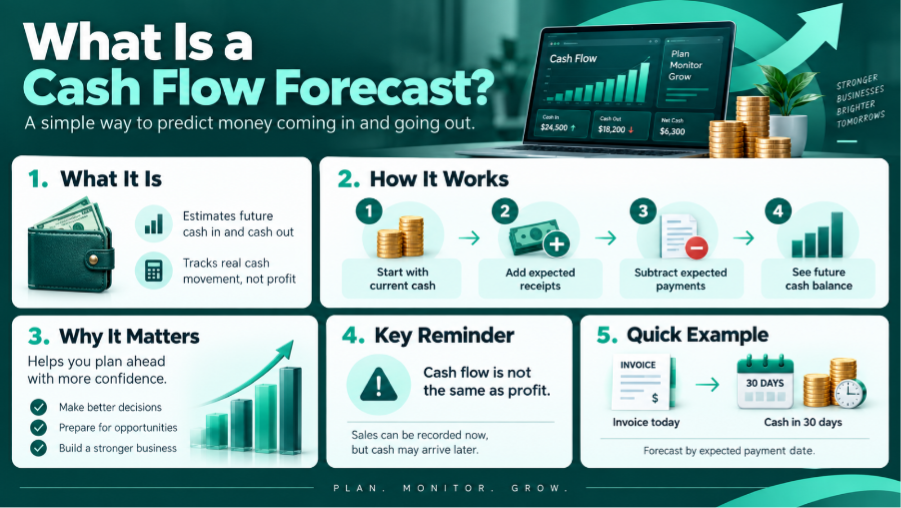
A cash flow forecast is a guess about the cash you will get and the cash you will pay in the future. It tracks real money. It does not track the profit on your income statement.
Start with the cash you have today. Add the money you expect to get. Take away the money you expect to pay. The answer is your expected cash for each period.
Here is an example. You send a customer an invoice with 30-day terms. You record the sale, but the cash comes in 30 days later. Your forecast should use the day you get paid, not the day you sold.
Uses Of a Cash Flow Forecast
The uses of a cash flow forecast go far beyond simple bookkeeping. It helps you plan your payments around the cash you will have. It helps you control your working capital each month. It also shows the months that need a closer look.
A forecast can help you plan your stock buying with more care. It can help you time supplier payments after your customers pay you. It can also help you decide if you can hire more staff.
Cash Flow Forecasting Process
A monthly cash flow forecast tracks the money that comes in and goes out each month. Follow these steps to plan your cash and stay away from money trouble:
1- Collect Your Business Records
Record the amount of money you can anticipate receiving every month. Record customer payments, cash sales, and other receipts of money.
2- List Expected Cash Inflows
List the amount of cash you expect to receive every month. Include cash sales and customer payments, among other sources of income.
3- List Expected Cash Outflows
Write down the money you expect to pay each month. Add supplier bills, salaries, rent, taxes, loans, and other costs.
4- Work Out Your Closing Cash
Start with the cash you have at the start of the month. Add the money you get. Take away the money you pay. The answer is your closing cash.
5- Check For Possible Cash Shortages
Look at the cash balance for every month. Plan how you will handle it if the cash looks very low.
6- Update Your Forecast Often
Your sales and costs can change during the year. Check your forecast often. Add your newest numbers.
Forecast Cash Flow Statement vs Actual Cash Flow Statement
An actual cash flow statement shows the cash that moved in months that are over. A forecast cash flow statement is a guess about the cash that will move in the future. It uses the facts you have now.
When you understand cash flow management and forecast well, you plan better. Look at the table below to see how the two statements are different:
This cash flow forecast advantages and disadvantages table shows that planning and reviewing are two different jobs.
Factor | Forecast Cash Flow Statement | Actual Cash Flow Statement |
Purpose | Estimates future cash receipts and payments for planning | Records cash receipts and payments that already occurred |
Example | Expects PKR 1,000,000 in cash inflows for March | Records show PKR 850,000 in actual inflows for March |
Main Benefit | Flags future shortages so payments can be planned ahead | Shows real cash position and supports performance review |
Accuracy | Depends on the quality of assumptions and available data | Reflects verified transactions, making it fully accurate |
Cash Categories | Groups expected operating, investing, and financing activities | Follows IAS 7, which classifies flows into operating and financing activities |
Update Frequency | Revised whenever key assumptions or conditions change | Updated automatically as transactions are recorded |
Business Value | Helps prevent cash shortages and payment pressure | Helps businesses evaluate what happened financially |
Why Cash Flow Forecasting Matters in Pakistan
In Pakistan, small businesses do not only have to contend with late payments but also with high inflation rates. The cost of utilities and taxes continues to rise as well. State Bank data shows that SME financing grew to about Rs. 686 billion by September 2025. Despite this, numerous traders and service companies have difficulty handling working capital and short-term cash shortfalls. The better the forecast, the fewer surprise shortages will occur. It also provides you with greater choice in hiring and stocking.
Benefits of Cash Flow Forecasting for Small Businesses in Pakistan
The benefits of a cash flow forecast assist small firms in handling money better. When you use it, you make better money choices each month.
- Cash shortages can be seen 3 to 6 months ahead of time, before they affect your bank account.
- Financing for the short duration can be made available beforehand, or better terms given to suppliers.
- Cash flow management and forecasting system set up with the sales team.
- A bank will require yearly forecasting if you wish to take out overdrafts or loans.
- No rush at the last moment for scheduling payments for FBR and salary disbursements.
Limitations of Cash Flow Forecast You Must Know
Even if you make a simple prediction, if you miss out on some cash payments, it can go wrong. Be careful with your forecast, and those problems can be avoided.
- Bad data or very hopeful sales guesses can make you feel safe when you are not.
- If the firms have an irregular nature of sales, the gap between forecast and actual numbers is likely to be greater.
- Rough guesses with no check on the gaps can lead to poor cash choices.
- An accurate forecast can be undermined by events not in anyone’s control, such as floods, strikes, or import bans.
Common Cash Flow Forecasting Mistakes
Even a simple forecast can go wrong if you forget some cash payments. Check your forecast with care, and you can avoid these problems.
1- Treating Sales as Cash Received
A sale does not always mean you got the money. If customers buy on credit, they may pay weeks later. Add the payment in the month you expect to get it.
2- Forgetting Extra Business Costs
Some costs do not come every month. These can be taxes, repairs, equipment, yearly fees, and more. Add each one to the month you expect to pay it.
3- Expecting Sales to Always Increase
Do not think your sales will grow each month. Look at your past sales and your busy months first. Use numbers that your business can really reach.
4- Ignoring Late Customer Payments
Late payments leave you with less cash. Check how long your customers usually take to pay. Use those times when you plan your future cash.
5- Not Updating Your Forecast
After your initial forecast, your business can change. Your cash can change due to new sales, new costs, or late payments. Check your forecast often and add your new numbers.
6- Keeping No Extra Cash
Surprise costs can leave you with very little cash. Try to keep some extra money for surprises. This cash helps you pay sudden costs without stress.
Cash Flow Forecast Formula and Core Concepts
The given cash flow forecast formula helps you find the closing cash for each period:
Opening Balance + Cash Inflows − Cash Outflows = Closing Balance
Simple Numeric Example for One Month
Cash Flow Item | July Amount (Rs.) | Calculation |
Opening cash balance | 500,000 | Starting balance |
Sales & customer collections | 800,000 | Total cash received |
Total cash inflows | 800,000 | 800,000 |
Rent, salaries, stock & bills | 900,000 | Total cash paid |
Total cash outflows | 900,000 | 900,000 |
Net cash flow | -100,000 | 800,000 − 900,000 |
Closing cash balance | 400,000 | 500,000 − 100,000 |
How to Prepare a Cash Flow Forecast for a Small Business in Pakistan
Making a forecast is easy when you do the same steps each month. You do not need to be an expert in accounts to start. A spreadsheet can do the math and keep your records neat.
Step 1: Forecast Period
Decide how far ahead you want to see your cash. Most small firms pick monthly forecasts for the next twelve months. Weekly forecasts are better if your payments are tight or urgent.
Step 2: Opening Balance
Start with all the cash you have when the forecast begins. For example, you might start with PKR 300,000 in cash. Do not count unpaid invoices, because you can’t use that cash yet.
Step 3: Cash Inflows
List every way money comes into your business each month. Add customer payments, cash sales, loans, and other money you get. For example, you may expect about PKR 700,000 in inflows this month.
Step 4: Cash Outflows
Write a list of all the monthly payments you’re putting towards. Include rent, salaries, utilities, supplier expenses, and loan repayments. For instance, you can budget PKR 620,000 in outflows per month.
Step 5: Net Cash Flow
Take your total outflows away from your total inflows. For example, PKR 700,000 minus PKR 620,000 is PKR 80,000. A plus number means your cash went up that month.
Step 6: Closing Balance
Add your net cash flow to your opening balance. For example, PKR 300,000 plus PKR 80,000 is PKR 380,000. This closing balance is the opening cash for next month.
Step 7: Spot Shortfalls
Look for months where your cash is very low. A low balance often means payment stress or weak collections are coming. For example, a balance below PKR 50,000 needs fast action.
Step 8: Compare Results
Always compare your forecast with your real results each month. Look hard at big gaps between the guess and the real numbers. For example, a 20% gap means you need to fix your guesses soon.
Small Business Cash Flow Forecast Template
A cash flow forecast template keeps your expected cash in, cash out, opening cash, and closing cash in one clear place. You can build it in Excel or Google Sheets. Each row is one type of cash item. Each column is one month of your forecast.
Plan Your Cash Flow with Confidence
Want a ready-made sheet? Download our free cash flow forecast template to organise your finances, forecast income and expenses, and make informed business decisions.
Cash Flow Forecast PDF
Download and print your free template.
Cash Flow Forecast Excel
Download and edit your spreadsheet.
Free cash flow forecasting resources for your business.
Best Cash Flow Forecasting Tools for Small Businesses
Many cash flow forecasting tools are open to small business owners. Excel and Google Sheets are good for beginners and small firms. They are free, simple, and easy to change. Growing firms can use software that links to bank data. These tools save time, but they often cost a monthly fee. Pick one that fits your business size and your budget.
FAQS
A cash flow forecast shows how much money may come into your business. It also shows when money may go out each month. This helps you plan payments and avoid cash surprises.
Add customer receipts and sales that you expect to earn. Add to that rent expenses, salaries, inventory purchases, bills, taxes, and loan repayments. In that way, you will have a clear picture of monthly cash needs.
Profit is what your business earns after costs are taken away. Cash flow is when money really comes in and goes out. A business can make a profit and still run short of cash.
Good sales do not always mean customers have paid you yet. Credit sales can slow down the cash that reaches your bank. This can leave you short for payments you must make soon.
Update your forecast when sales or costs change from your plan. Also check it after big payments or customer delays. Regular updates keep your forecast close to the real picture.
Yes, a new enterprise can begin with basic guesswork figures. Take your projected sales, cost structure, collection of money from customers, and payments to suppliers. Adjust these figures based on the actual outcomes.
First, find the month with the biggest cash gap. Then check your payment dates and think about delaying spending you don’t need right now. You can also plan early to get extra funds.
Final Thoughts
A cash flow forecast provides small business owners with a better understanding of their cash. It shows when money is expected to be received and when it needs to be paid. This allows planning and helps to prevent problems with cash shortages that would have a negative impact on daily operations.
Regular cash planning for small businesses in Pakistan will make it much easier for them to pay their bills, maintain control over cash outflows, and prepare for the future. It’s also possible to create a more robust planning system with expert assistance.
At PFOC, our team of financial experts can help you make cash flow forecasts, review your business numbers, and plan your future cash needs. We can also assist you in understanding some of the places your cash is going and how you can better prepare it.